

Four Per Cent of the Emails: Why the AI Customer Service Revolution Looks So Slow
13 August 2026Saying ‘Lean’ Is Not a Skill
People are becoming aware that this buzzword Bingo masks a lack of knowledge….
In June I sat in a steering meeting at a 2,000-person logistics business while the Managing Director, flanked by the head of PMO, explained with a straight face that the transformation programme was ‘applying Lean principles’ to the finance close.
I asked which principles.
‘Removing waste,’ he said.
I asked which wastes. There was a longer pause, and then he offered, ‘You know. Waste. Duplication, mainly.’ The Chief Operating Officer nodded along, because the COO had used exactly the same words in the executive review the previous Tuesday, and nobody in the room had the appetite, or wanted to take the risk, to find out whether any of them could go a layer deeper.
Let’s be patient with them, because I have met this conversation in banking, in pharma, in professional services and in more manufacturing head offices than I can count, and these individuals are almost never solely the problem, although them thinking they know what they are talking about is a real issue. The problem is that somewhere in the last fifteen years, continuous improvement stopped being a discipline people learned and really understood and became a vocabulary acquired and parroted out, pretending you had the required knowledge to truely make improvements. Twenty years ago, saying ‘we do Lean’ generally meant someone in the building had stood on a factory floor for a long time, been coached by someone difficult, and earned the right to the sentence. Now it means someone completed a two-hour e-learning module and owns a Jira board.
Saying ‘Lean’ is not a skill. It is a password.
Fluent in the vocabulary, blind to the process
Here is the steel-man version of the executive position, because it deserves one. The core principle of Lean is simple to state: respect the people doing the work, and relentlessly remove whatever the customer would not pay for. An intelligent COO can grasp that in ten seconds, and the accessibility is a feature, not a fraud. The Toyota Production System was built so the thinking would be available to everyone, not locked inside a specialist ‘priesthood’
But fluency in the vocabulary of a discipline is not fluency in the discipline. You can say ‘reduce the inflammation’ with total confidence. Nobody should let you prescribe the drugs to do it.
The eight wastes make the point better than I can. Ask a room of transformation leads how many wastes there are and most will now say eight, because the count has made it into the training decks. Then ask them to name the eight, and watch. You will get defects, you will get waiting, you will usually get ‘duplication’, which is not one of them, and then the list dries up somewhere around number four. The eighth, the underuse of people’s skills, is the late addition that turned Taiichi Ohno’s original seven into eight, and it is not a coincidence that it is the one leadership teams forget.
Naming them is the entry fee, not the skill. The skill is walking a process and pointing at them in real time. An expert does not need their own waste session before engaging with SMEs; a simple review establishes the high-level wastes instantly, because it is a natural way of looking at everything we actually do. The translation from shop floor to office is not difficult, but it does have to be done by someone who has made it before.
| Shop floor origin | Modern office reality |
|---|---|
| Overproduction | Reports generated weekly, read quarterly |
| Inventory | Approval queues sitting invisibly in inboxes |
| Motion | Swivelling across six systems to answer one question |
| Overprocessing | Three-signature sign-off on a £40 expense |
| Defects | Rework caused by unclear inputs and broken handoffs |
| Waiting | Multi-day delays for a thirty-second approval |
| Transport | Endless email chains and file transfers |
| Underutilised skills | Subject matter experts doing admin |
If a leader cannot make that translation from an assembly line to their own software stack, they do not understand waste. They have a pub quiz answer.
The project & product managers, PMO heads and COOs I meet can name the goal. What they mostly cannot do is see waste in a process, distinguish it from necessary work, trace a problem to a cause rather than a symptom, design a controlled test of a change, or hold a standard once one exists. Those are the actual skills of continuous improvement. They take years, they are learnt at the level of the work rather than the level of the deck, and there is no version of them that fits in a town hall slide.
The result is a strange corporate condition in which everyone above a certain grade is fluent in Lean and almost nobody can improve anything.
Too much hassle, apparently
Meanwhile, in the businesses that actually have manufacturing, something stranger is happening. Operations directors will tell you, often in the same meeting, that Six Sigma is ‘too much hassle’ and that they are ‘rolling Lean out across the whole business’. Which is a curious pairing of positions from people whose scrap rates are a standing agenda item.
Six Sigma earned some of its reputation, and I do not pretend otherwise. Somewhere around 2005 it stopped being a method for reducing variation and became a certification economy, with belt colours, gate reviews and nine-month projects that concluded, statistically, what the shift team had known in week one. If your experience of Six Sigma was a Master Black Belt consultant arriving with a Minitab licence and leaving with brown paper on every wall that nobody ever looked at again, your scepticism is rational.
But the variation did not go away because the method annoyed and frustrated you. The scrap, the rework, the customer complaints that cluster on one line, one shift, one supplier: those are variation problems, and Lean does not solve variation problems. Lean solves flow problems. Declining the one method built for the losses actually costing you money, on grounds of hassle, while enthusiastically applying the other method to areas it was never designed for, is not a strategy. It is a preference for the tool that photographs better.
And the enthusiastic application without in-depth knowledge does real damage, which is the bit nobody wants in the retrospective. I have watched a shared services centre remove a ‘redundant’ reconciliation step that turned out to be the only thing catching a recurring supplier billing error; it ran undetected for five months, and the recovery cost more than the step had cost in a decade. I have watched buffers stripped out as ‘waiting waste’ from processes whose whole resilience depended on them, so that one absence or one system outage now stops everything. I have watched experienced people reclassified as spare capacity because their real contribution, absorbing the variation nobody had measured, was invisible to whoever drew the value stream map.
There is a name for what went wrong in each of those cases, and it is not bad luck. Somebody treated waste identification as a labelling exercise rather than an act of understanding. The reconciliation step looked like overprocessing. The buffer looked like waiting. The experienced people looked like underused capacity being redeployed, which sounds almost virtuous if you say it quickly. In every case the label was applied before the process was understood, and in every case the process got its revenge, with interest, in somebody else’s cost centre.
Waste removal without process understanding is not Lean. It is cost-cutting wearing a Toyota lanyard.
The SCOPE-X framework, and why it is deliberately unoriginal
At AMVEN Improvementors, the frame we use for continuous improvement outside manufacturing has five stages and a letter that refuses to stay in its lane: Sense, Clarify, Options, Proceed, Embed, and X for Experience. SCOPE-X, if you want the acronym, and none of it is new. It is a deliberate synthesis of OODA, PDCA and DMAIC, because those loops have between them about a century of evidence behind them and the world does not need another proprietary methodology pretending it invented iteration. What it needs is a version that works where there is no takt time and no visible flow, and where the gemba is a laptop, a shared drive and a Teams channel.
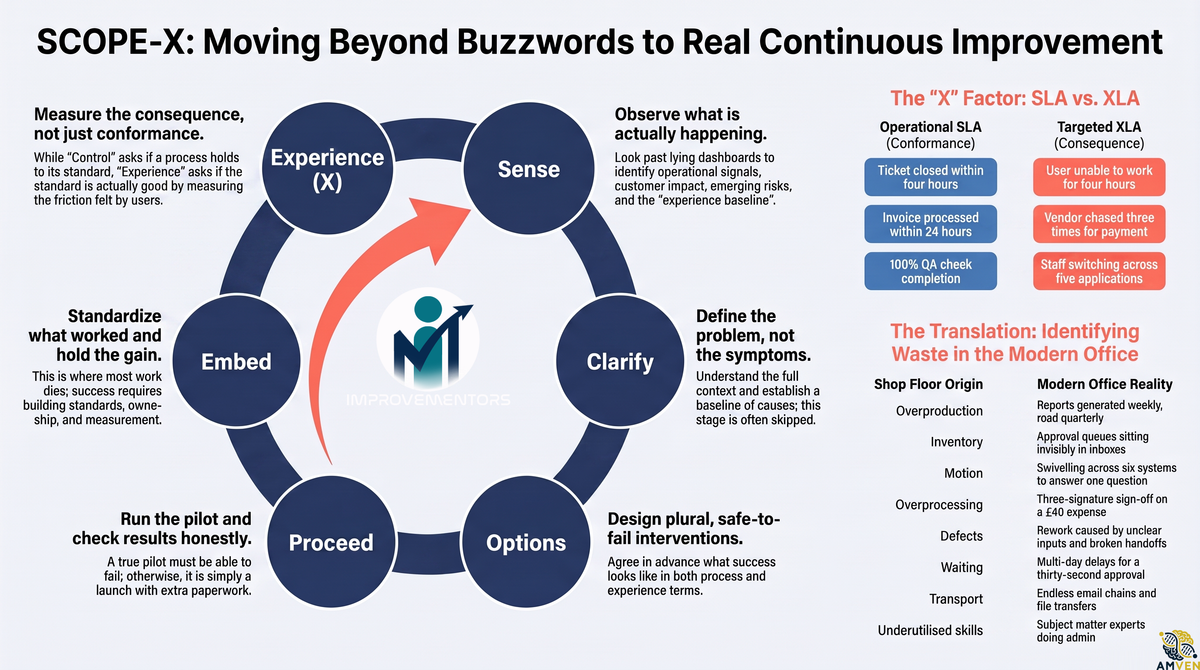
Sense. Observe what is actually happening: the operational signals, the customer impact, the emerging risks, and, because of what happens at the other end of this loop, the experience baseline. What the work currently costs the people doing it and the people receiving it. OODA’s Observe, DMAIC’s Measure. In knowledge work this is the stage everyone skips, because the work is invisible and the dashboards are lying, and it is why I spent a whole earlier piece dragging [LINK: Ohno’s chalk circle] into the digital age. You cannot improve a process you have only inspected through a status dashboard, and you certainly cannot spot eight wastes you cannot name.
Clarify. Define the problem rather than its symptoms, understand the context, establish the baseline and explore causes. OODA’s Orient, DMAIC’s Define and Analyse. This is the stage the ‘remove waste’ crowd believe they have completed because they have named a symptom.
Options. Design more than one safe-to-fail intervention, and agree in advance what success looks like, in process terms and in experience terms. OODA’s Orient again, PDCA’s Plan. The plural is doing deliberate work: the first idea in the room is usually the loudest person’s idea, and the two are correlated in no useful way. And ‘in advance’ matters more than anything else in the stage. If success is defined after the pilot, it will be defined as whatever the pilot achieved.
Proceed. Decide, act, run the pilot, check the results honestly. OODA’s Decide and Act, PDCA’s Do and Check, DMAIC’s Improve. Honestly is the operative word. A pilot that cannot fail is not a pilot, it is a launch with extra paperwork.
Embed. Standardise what worked, assign ownership, monitor performance and adapt when conditions change. PDCA’s Act, DMAIC’s Control. I will be blunt about this one: Embed is where I have watched more improvement work die than everywhere else combined. The workshop happens, the pilot succeeds, the storyboard is presented, and six months later the process has drifted back to exactly where it started because nobody built the standard, the measurement or the ownership to hold the gain. If your organisation has run forty Kaizen events and cannot show you forty held standards, you do not have a continuous improvement capability. You have a workshop habit. Holding the standard is necessary. It is not sufficient, which is what the last letter is for.
X – What Control was never designed to see
Go back to the shared services centre and the reconciliation step. Five months. The part worth sitting with is not that nobody caught the billing error. It is that the people doing the work almost certainly knew something had gone wrong long before the finance number moved, and there was no measure anywhere in that organisation capable of hearing them.
Every process metric was green. Cycle time had improved, because a step had been removed. Cost per transaction had improved, for the same reason. The control chart, had anyone drawn one, would have shown a process comfortably within its limits, doing exactly what it had been redesigned to do. DMAIC’s Control stage would have signed it off without a flicker, because Control asks whether the process is holding to its standard. It does not ask whether the standard is any good.
That is the gap X exists to close. Control measures conformance. Experience measures consequence.
So SCOPE-X ends with Experience, and in practice that means building an XLA: an experience level agreement, borrowed from service management, sitting alongside the SLA and asking the question the SLA cannot.
| Operational SLA (conformance) | Targeted XLA (consequence) |
|---|---|
| Ticket closed within four hours | User unable to work for four hours |
| Invoice processed within 24 hours | Vendor chased three times for payment |
| 100% QA check completion | Staff switching across five applications |
Both columns can be true at once, and only one of them is usually on the dashboard.
An XLA is only worth having if it is specific, which is where most attempts fall over. ‘User satisfaction’ is not an XLA, it is a satisfaction survey wearing a new hat, and it will tell you in eleven months that morale is down. Useful experience measures are narrow and countable: how many times a requester has to chase before anyone answers, how many systems one person touches to close one case, how long it takes from a question being asked to a human replying, how many exceptions the process throws back at the people it was meant to serve. Set a threshold, watch it weekly, and treat a breach the way you would treat a process going out of control, because that is what it is.
And be honest about how these things die. An XLA goes bad the moment it stops being a signal somebody reads and becomes a number somebody owns. Put it on a bonus in the first quarter and it will be green by the third and meaningless by the fourth. The measure survives only where the person accountable for the process is genuinely allowed to report a bad reading without it turning into a performance conversation. If your organisation cannot do that, do not build the XLA. Build the culture that could tolerate one, and come back to it.
There is a neat symmetry with the eighth waste, the one everybody forgets. The underuse of people’s skills almost never registers on a throughput dashboard, because process metrics count output and this waste sits in what was never asked for. It surfaces in an experience measure immediately.
And because a reading only means anything against a prior reading, X reaches back into Sense. You take the experience baseline at the same time as the process baseline, before anyone has touched anything, while the people doing the work still have no reason to perform for you. Adding a letter to the end of the acronym changes what you have to do at the start of it. That is not an inconvenience. That is the loop working.
Three things to do this week if any of this stings
First, the cheap one. Next time someone in a meeting says ‘Lean’ or ‘remove waste’, ask them which wastes, and if they say there are eight, ask them to name the eight, with an example of each from your own order-to-cash or onboarding workflow rather than from a car plant they have never visited. Not to embarrass them. To find out, kindly and early, whether you have capability or vocabulary. The gap between ‘there are eight wastes’ and ‘here are the eight wastes in our order-to-cash process’ is the gap this whole piece is about.
Second, find a process your organisation streamlined in the last twelve months and ask what the removed steps, buffers and handoffs were quietly catching before they went. In my experience roughly one in three was performing an inspection or an escape-catch that nobody had documented, and the cost of its absence is currently sitting in someone else’s numbers under a different name. This audit is unpopular and worth doing precisely because it is unpopular.
Third, take one change your organisation declared a success this year and measure what it did to the people running it. Not satisfaction. One countable thing: chases, handoffs, systems touched, days waiting for a human answer. You will probably find nobody measured it beforehand, which means you cannot answer the question, which is itself the answer.
And if you run manufacturing and you walked away from Six Sigma somewhere around the belt-bureaucracy years, separate the method from the ‘priesthood’ You do not need to certify another belt as long as you live. You do need the measurement discipline, the baseline, and the willingness to treat variation as a problem with causes rather than a personality trait of the night shift. Take the statistics, leave the ceremony.
Continuous improvement was never the words. It was never the belts either. It is the unglamorous ability to see work clearly, change it carefully, hold the change, and then find out honestly what the change did to the people living inside it.
Which wastes. It is still a good question. Somewhere in your next steering meeting, there is a pause waiting to happen.
Frequently asked questions
What is the difference between Lean and Six Sigma?
Lean improves flow: it shortens lead time and removes activity the customer would not pay for across an end-to-end process. Six Sigma reduces variation and defects using measurement and statistical analysis. They solve different problems, and applying flow tools to a variation problem is one of the most common and expensive mistakes in operational improvement.
What is an Experience Level Agreement (XLA)?
An XLA measures the practical friction experienced by the people using a process or service, rather than the process’s compliance with a target. An SLA records that a ticket closed within four hours. An XLA records that somebody could not do their job for four hours. Useful XLAs are narrow and countable: chases, system switches, exceptions pushed back onto the user.
Why do Lean transformations fail in office and knowledge work environments?
Because leadership teams remove visible steps without understanding the hidden inspection, coordination or variation-buffering those steps were performing. In knowledge work the inventory sits invisibly in inboxes and ticket queues, so waste cannot be identified without direct structured observation of how the work is actually done.
Andy McGurk is a Fractional Chief AI Officer and continuous improvement director working with UK and European organisations, and the founder of AMVEN. He has been asking people ‘which wastes’ since roughly 2009 and has not once been thanked for it. Connect with Andy on LinkedIn
