

The PHP fix landed at 2.34 this afternoon. Here is what it means for your InstaHost site, and why moving everyone to 8.5 is only half an answer
21 October 2026“Driving Value” it’s the new mantra being repeated through organisations globally, and is rapidly becoming part of the Office Bingo game, alongside “Did you use A.I on that” and “we should be able to automate that”. Of course to requirement to realise value should be second nature to improvement and transformation specialists anyway – “should be” is the key poijnt here. Value realisation has, over the past 30 years been spoken about, but actual realisation has been actively ignored by many c-suites, considered a waste of time and a barrier to their vanity projects – which have then been allowed to run for years and eventually being abandoned – c-suites definitely do not want to realise their own losses!
In the last week of September a transformation director at a major UK insurer walked me through the sixty-slide deck for her operational excellence programme. It was a good deck (as far as these brain numbing slide decks over 15 slides go). Despite taking ages to get to it, Slide 41 was the one I kept going back to. It listed the programme’s quality measures, and there were two of them: Copilot adoption, and completion of a mandatory data-handling course.
Neither of those is a quality measure. They are inputs. Nobody on the slide was counting how often an underwriting file came back for correction, how many versions a board paper went through before it was signed off, or how many hours a week the claims team spent chasing information that had been sent to the wrong person on the wrong channel ( or for that matter, how many hours had been lost to this bloated slide deck and the pretty icons/images)
Three days later, at a different client, I sat in on a Teams call where a Master Black Belt proposed measuring the quality of a procurement process in defects per million opportunities, sampled from 200 purchase orders. Someone asked what counted as an opportunity. There was a long pause. The answer, when it came, was a slide from a 2009 training course with a photograph of a bottling line on it.
Two failures, pointing in opposite directions. And the thing they have in common is that neither of them has noticed that is going to be 2027 in less than three months and also the office changed.
Where the four buckets came from, and what they were built to count
Cost of Quality is one of the few genuinely good ideas in management. Joseph Juran put the economics of quality into his Quality Control Handbook in 1951. Armand Feigenbaum gave it the structure most people recognise in a 1956 Harvard Business Review article (yes, 70 years ago), and later coined the phrase that still does the heavy lifting in every quality course I have ever sat through: the hidden plant, the factory inside the factory that exists only to rework, repair and replace what the first factory got wrong. Philip Crosby made it a boardroom argument with Quality is Free in 1979 (a mere 47 years ago).
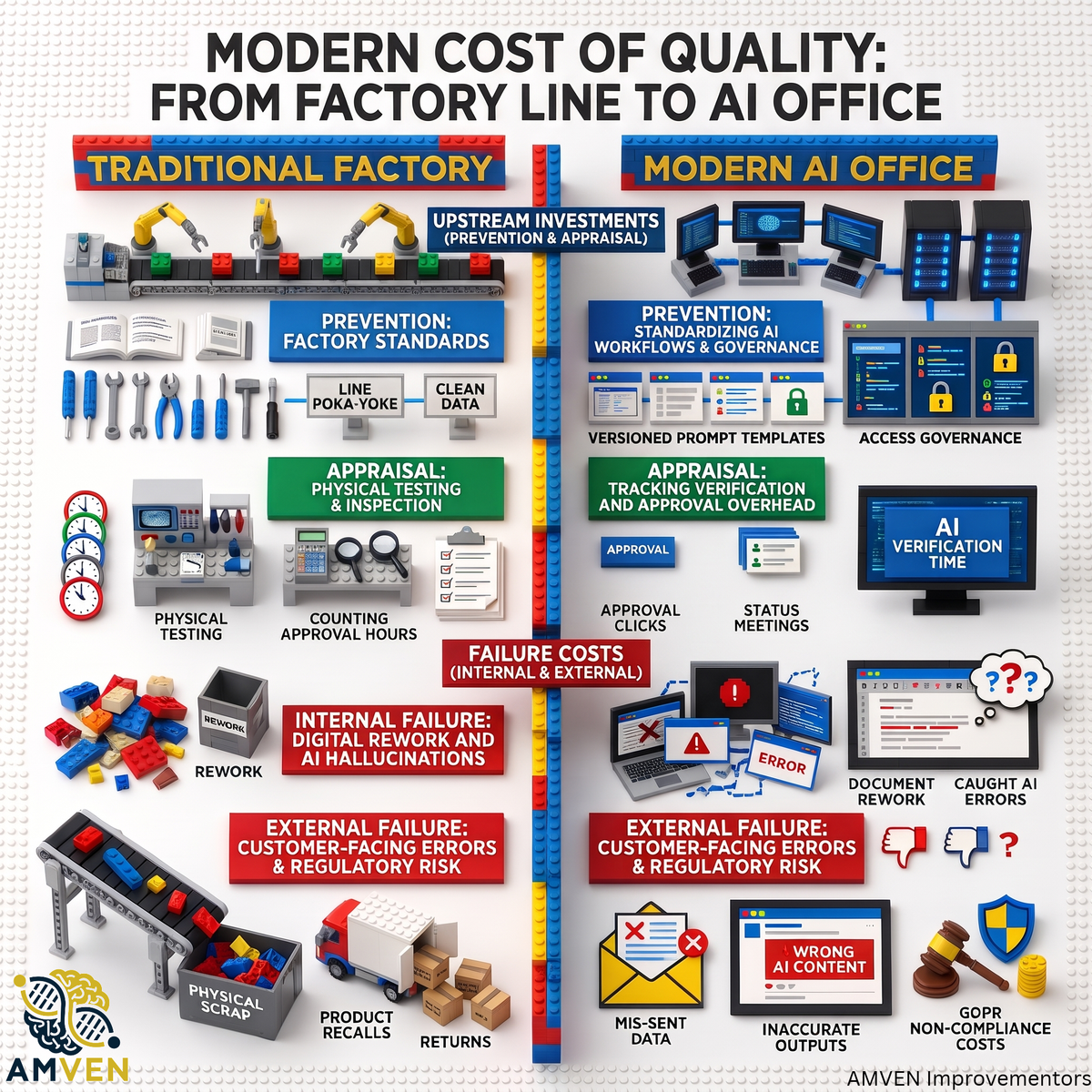
The model itself is simple. Four buckets. Prevention is what you spend to get it right first time. Appraisal is what you spend checking whether you did. Internal failure is what it costs when you find out you did not, before the customer does. External failure is what it costs when the customer finds out first. The first two are the cost of good quality. The last two are the cost of poor quality. The American Society for Quality still quotes the rule of thumb that quality-related costs run at 15% to 20% of sales revenue in many manufacturers, and up to 40% of operations in the worst.
Then there is the curve, the one on every infographic. Failure costs fall as conformance rises, prevention and appraisal costs climb, and the total has a minimum somewhere. Juran’s original version put that minimum short of perfection, which is why a generation of plant managers learnt that chasing zero defects was uneconomic. The fourth edition of his handbook quietly moved the optimum to 100% conformance, on the grounds that automation and better prevention had made the right-hand end of the curve cheap.
It’s important to notice what the model assumes. It assumes failure is visible: there is a scrap bin, and someone can weigh it. It assumes appraisal happens at a gate, by a person whose job is appraisal. It assumes the cost of producing one more unit is roughly constant. And it assumes everyone involved is standing in the same building.
In 1979 all four of those were true of a factory. In 2026/27 none of them is true of an office.
The people who think it is simple, and the people who think it is 2009
The first camp is the larger one. Most people now running transformation, change or ‘ways of working’ programmes in UK and European offices have never been trained in any quality discipline. They came up through project management, HR, digital or consulting, and they have absorbed a vague sense that quality is a manufacturing concern, something to do with tolerances and clipboards. Their improvement programmes measure activity: tickets closed, licences activated, hours of training delivered, net promoter scores from a pulse survey. The strongest version of their position is that office work is contextual, creative and relational, that you cannot put a micrometer on a board paper, and that imposing factory metrics on knowledge workers produces gaming and resentment. They are right about that last part. I have watched it happen.
The second camp is smaller, better qualified, and in some ways more dangerous, because it arrives with a certificate. These are the Lean and Six Sigma practitioners, many of them very good, who learnt their craft on a shop floor or in a shared service centre in the 2000s and are now being asked to improve a hybrid finance function or a legal operations team. Their instinct is to reach for what worked: value stream maps, DPMO, control charts, a Kaizen event in a room with a lot of Post-it notes. The strongest version of their position is that the arithmetic of Cost of Quality does not care what the product is. A mistake is a mistake; rework is rework; a cost is a cost. They are right about that too.
The problem is that the first camp has no way of putting a number on quality at all, and the second camp has a way of putting a number on the wrong thing.
The Master Black Belt on that Teams call was not wrong that procurement has defects. He was wrong about where they live. The defect in a modern procurement process is not a mis-keyed purchase order. It is the fourteen-message Teams thread in which three people in two countries try to establish who approved the thing, the automated workflow that failed silently on a Friday afternoon because a SharePoint column was renamed, and the Copilot-drafted supplier summary that nobody checked because it looked finished. None of those shows up in a sample of 200 purchase orders. All of them cost money.
The two camps are not really arguing with each other. They are mostly not in the same meeting.
The curve has flipped, and almost nobody has redrawn it
Juran’s curve assumed that producing a unit of output had a cost, that checking it had a cost, and that the two were in the same order of magnitude. That is why the prevention-and-appraisal line climbs gently and the failure line falls steeply, and why they cross somewhere sensible.
Neither of those assumptions survives contact with a modern office.
In an AI-assisted office, the cost of producing a unit of output has collapsed. A first draft of a board paper, a supplier risk summary, a customer email, a piece of analysis, a chunk of Power Automate: any of these can now be generated in under a minute by anyone with a licence. Generation is close to free. But the cost of checking that output has not collapsed. If anything it has gone up, because the output arrives looking finished, with confident prose and plausible numbers, and the person checking it has to work harder to find the error than they did when the junior analyst’s draft looked like a junior analyst’s draft.

So appraisal, which in Feigenbaum’s model was a modest, gated activity carried out by a named inspector, is now the dominant term in the equation. It is distributed across everyone. Every manager is an inspector. Every reviewer of a Copilot summary is doing appraisal, usually without recognising it as such, usually without it appearing on any timesheet or cost line. The office has not hired a quality department; it has turned the entire workforce into one, part-time and untrained.
Meanwhile failure has gone invisible in a way the factory never allowed. On a shop floor, rework is a physical act. You can see the pallet being wheeled back. In an office, rework looks exactly like work. Version seven of the deck looks like diligence. The second meeting to re-decide what the first meeting decided looks like collaboration. The hour spent re-asking in a Slack channel for information that was sent to a different channel looks like communication. And since January to March 2025, when the ONS recorded 28% of working adults in United Kingdom in hybrid arrangements and 45% of managers, directors and senior officials, a large share of that invisible rework happens across two or three locations and a time lag, which is where handoff errors breed.
Automation makes it worse, not better, if it is done the way most offices do it. A brittle RPA bot or a Power Automate flow built by an early adopting enthusiast in 2023 does not fail loudly. It fails silently, on a Friday, and the failure is discovered three weeks later as an external failure cost: the customer who did not get the renewal letter, the regulator who did not get the return. One bad prompt template or a flow created on the users own account but then deleted when the user leaves the organization, saved as a team standard and reused 10,000 times, is a defect at a scale no factory ever achieved from one operator’s mistake.
Put those together and the curve does not have a gentle minimum any more. Failure is cheap to create and expensive to find. Appraisal is everywhere and unmeasured. Prevention, the one bucket that actually gets cheaper with good AI and automation, is the bucket almost nobody is funding, because its budget line is called something else, and the constant need for speed – simply considers fundamental guardrails as barriers which is paid lip service and then ignored.
That is the office the Six Sigma formulas were never drawn for. It is also the office the untrained camp cannot see at all.
The four buckets, redrawn for an office with Copilot in it
I am not proposing to throw the model away. Feigenbaum’s four buckets are still the right four. What has to change is what goes in them, how it is counted, and the recognition that AI and automation sit in all four at once rather than being a separate line called ‘technology’.
| Bucket | What the factory counted | What a hybrid, AI-assisted office should count now |
| Prevention | Design reviews, supplier qualification, operator training, poka-yoke on the line | Standard work for knowledge tasks (who decides, in what channel, by when). Data quality fixed at source, not in the spreadsheet. Prompt and agent templates that are versioned, owned and tested. Access governance: who can plug which model into which data. Automation built with error handling and an owner. |
| Appraisal | Inspection, sampling, lab testing, calibration | Review and approval hours, counted. Number of approvers per decision. Time spent verifying AI output before it is used. Status meetings, which are inspection by another name. Reconciliation work between systems that should agree and do not. |
| Internal failure | Scrap, rework, re-inspection, downtime | Rework hours on documents, analysis and code. Re-opened tickets and bounced approvals. Automation runs that failed and were re-run or hand-patched. Hallucinated or wrong AI output caught internally and redone. Information re-requested because the first request went to the wrong person, channel or time zone. Meetings held to re-decide. |
| External failure | Warranty, recalls, returns, lost customers | Errors reaching customers, regulators or the board. Mis-sent data and the GDPR cost that follows. Published AI-generated content that was wrong. Silent automation failures discovered by the customer. Reputational and remediation cost, including the consultancy you then hire to explain it. |
Two things in that table deserve more than a cell.
The first is verification cost. In every client I have looked at this year, the single largest unmeasured quality cost is the time people spend checking what a model produced. It is appraisal, and it belongs in the appraisal bucket, and it is currently booked nowhere. Once you count it, two things follow. You discover that ‘adoption’ has been inflating appraisal cost rather than reducing total cost, which is awkward for the slide-41 crowd. And you discover that the organisations getting real value from AI are the ones that spent on prevention first: clean data, tested templates, clear decision rights, so that the output needs less checking. Which is exactly what Juran said 75 years ago in 1951, in a building full of lathes.
The second is automation debt. Every office now carries a layer of small automations, flows, macros and bots built by well-meaning people who have since changed jobs. Nobody owns them. Nobody tests them. They are prevention spend that has quietly become a failure liability, and the only way to see them is to count the failures they cause. A client in Dutch logistics found 340 Power Automate flows in production last spring. Eleven had a named owner still employed by the company. That is not a technology problem. It is a Cost of Quality problem wearing a lanyard.

One number the finance director will repeat in the lift
The reason Cost of Quality worked in manufacturing was not the four buckets. It was that Crosby could walk into a boardroom and say ‘you are spending 20% of revenue on getting things wrong’, and the board could check the figure against the accounts. The office version has to do the same thing, and it cannot do it with DPMO, because no chief financial officer has ever lain awake worrying about defects per million opportunities.
The unit of account in an office is payroll. So that is what you measure in.
The method I now use is deliberately unsophisticated. Pick a function: claims, procurement, financial close, legal operations, a product team. Take a fortnight. Have people, or where the tooling allows it the systems themselves, classify what they did in fifteen-minute blocks into five headings: value work, prevention, appraisal, internal failure and external failure. Not activity codes, not Jira categories, just those five, with plain definitions and a dozen worked examples on one side of A4. If a block was spent checking a Copilot summary, that is appraisal. If it was spent redoing a report because the data was wrong, internal failure. If it was spent in a meeting to decide something that was already decided last Tuesday, internal failure, and write down which meeting. Readers of the Digital Ohno Circle Workbook will recognise the stance: stand still, watch the work, write down what is actually happening rather than what the process map says is happening.
Then multiply the hours in each bucket by the loaded hourly cost of the people in it, and annualise. You now have a Cost of Quality for the function, in pounds, that reconciles to the payroll ledger. Put the four buckets on one slide. Put a single ratio above them: hours spent finding and fixing mistakes divided by hours spent doing the work. I call it the fix-to-build ratio, because the name tells you what it is and because the C-suite will not repeat anything with more than four syllables in it.
For illustration only, since the numbers in your organisation are the whole point: suppose a 2,000-person operations function at a loaded cost of £65,000 a head, and the fortnight shows 9% of time in appraisal and 14% in internal and external failure. That is £29.9 million a year of payroll spent checking and correcting, and a fix-to-build ratio of roughly 0.3. Every executive in the room can do the arithmetic on what halving it would be worth, and nobody needs a control chart.
The AI business case then writes itself, and it is a different business case from the one in most board packs. It is not ‘we will adopt Copilot and productivity will rise by some percentage a vendor gave us’. It is ‘here is £29.9 million of failure and appraisal cost; here is the share of it that better prevention would remove; here is what that prevention costs, including the governance, the data work and the access controls; here is the fix-to-build ratio we commit to hitting by Q3 next year’. AI, in that framing, is a prevention investment measured by the fall in failure cost. Adoption does not appear anywhere on the slide, which I regard as a feature.
It also gives you an honest way to price the value of automation. An automation that removes four hours a week of reconciliation is worth those four hours at loaded cost, minus the appraisal cost of checking its output, minus the expected failure cost when it breaks, minus the cost of someone owning it. Most automation business cases I see include only the first term. The other three are where the money goes.
What a UK CAIO should do this week
Find out what your quality measures actually are. Pull the transformation programme’s dashboard and the AI programme’s dashboard and look for anything that counts failure or rework in hours or pounds. If, as is likely, everything on both is an input measure (licences, logins, training completions, prompts per user), you have found the problem, and you can stop reading vendor benchmarks for a while.
Run the fortnight. One function, five headings, fifteen-minute blocks, one side of A4 of definitions. Do not build a tool for it. Do not procure anything. A spreadsheet and a conversation with the function head will do. The point is the number, and the number is persuasive precisely because it is crude and reconciles to payroll; the moment it becomes a ‘time intelligence platform’ it stops being believed. Be prepared for the appraisal bucket to be larger than anyone expected and for the function head to be slightly offended by it. That is the reading, not the error.
Count your automations. All of them, including the flows and bots and macros that were never registered anywhere. For each one, two questions: who owns it, and what happens when it fails. The second answer is a failure cost you are currently carrying off the books.
The hidden plant, seventy years on
Feigenbaum’s hidden plant was a factory inside a factory. It was hidden because nobody had drawn its boundary, not because it was hard to see. Once you went looking, there were the people, the floor space and the scrap, and you could put a cost on all three.
The hidden office is harder. It is distributed across kitchen tables in Peterborough and Utrecht and a floor in Canary Wharf that is full on Wednesdays. Its rework looks like diligence. Its inspection is done by everyone and recorded by nobody. Its scrap bin is a Teams channel. And it has just been handed a machine that produces plausible work at no marginal cost, which means the only thing left to pay for is finding out whether the work is right.
Juran moved his optimum to 100% because automation made the right-hand end of the curve cheap. He was correct, for a factory. In the office, AI has made the left-hand end of the curve cheap instead. Producing a defect now costs almost nothing. Finding it costs the same as it ever did.
The transformation director with the sixty slides sent me a note last week. She has started the fortnight. Slide 41 is being redrawn.
AMVEN Improvementors are founding members of The Faculty of Transformation Excellence (TFTE), TFTE exists to redefine transformation, continuous improvement and operational excellence for the place most work now happens — the modern, AI – and automation- capable office, not the factory floor.
The discipline itself is sound: define the problem, measure it, remove what does not add value, hold the gain. But the toolkit most practitioners are still taught was built for 1950s manufacturing. Value stream maps drawn for physical parts, changeover reduction designed around machines, 5S written for a workshop, control charts tuned to production runs — none of it translates cleanly to a claims team, a finance function or a service desk, where the unit of work is a decision, a document or a case, the bottleneck is almost always a handoff or an approval, and the “machine” is now a workflow tool, an automation bot or a large language model.
The result is a generation of certified practitioners who can recite the method but struggle to apply it where their employer is actually losing money and time. TFTE builds and certifies the modern version: improvement tools designed for knowledge work and administrative flow; automation and AI treated as capabilities to be deployed deliberately, measured and governed, rather than bought and bolted on; and certification earned on an assessed workplace result rather than just an exam – this is not a test of memory – this is about capability.
TFTE ( and AMVEN ImproveMentors) are not replacing Lean and Six Sigma. We are finishing the job they started, for an environment their founders never saw.
You know something’s slow, costly or quietly broken. AMVEN ImproveMentors — founding members of TFTE — offer certification, training, and consultants who do the work with you, not to you. Contact Us Today!
Andy McGurk is a Fractional Chief AI Officer, Continuous Improvement Leader and Operational Excellence Expert, and the founder of AMVEN which helps UK and European organisations build AI and transformation strategies that treat frontier AI as infrastructure rather than software. He has spent over twenty years in operational excellence and technology leadership, is based in Peterborough, and has been trying to get knowledge workers to stand still and watch their own process since well before anyone called it an observation log.


