Saying ‘Lean’ Is Not a Skill
26 August 2026
The PHP fix landed at 2.34 this afternoon. Here is what it means for your InstaHost site, and why moving everyone to 8.5 is only half an answer
21 October 2026Bottom Line: True Kaizen is a daily habit built on six interdependent elements, not a three-day workshop. Here is why most corporate continuous improvement events fail to stick.
“We’ve done four Kaizens this year,” the Managing Director, in a tone that suggested I should be impressed. This mindset is a perfect example of the Kaizen Fallacy.
I asked what was different as a result.
She walked me through February 2026. Three days, brown paper on every wall of a meeting room, a cross-functional team, crappy sandwiches and pizza all round, a storyboard, the obligatory photograph of everyone standing in front of the brown paper, and a teams post and article in the company internal newsletter, put together by a comms person who didn’t even attend. Genuine energy in the room, by her account, and I (sort of) believe her. People generally enjoy these. It is the only three days all year when somebody asks them what is wrong with the work and then writes the answer down.
I asked what was different now.
Kaizen is not a countable noun. You cannot have done four of them, any more than you can have done three fitnesses this year and one of them went really well.
Let me be fair to her before I go further, because the focused improvement event is not a fraud and I have run plenty of them. Toyota runs them too. They do something daily operations will never do on their own, which is to concentrate serious attention on one problem for long enough to understand it, with the right people in the room and their normal work covered by somebody else. That is genuinely valuable and it is genuinely hard to arrange. The trouble is not the event. The trouble is when the event is the entire system rather than a punctuation mark inside one.
Masaaki Imai, who gave the word its currency outside Japan with his 1986 book, was describing something closer to a habit than a project. Small changes, continuously, by everybody, as part of the work rather than as an interruption to it. Somewhere between that and that communication piece celebrating the event, the meaning has drifted.
Six Kaizen elements, and the uncomfortable test
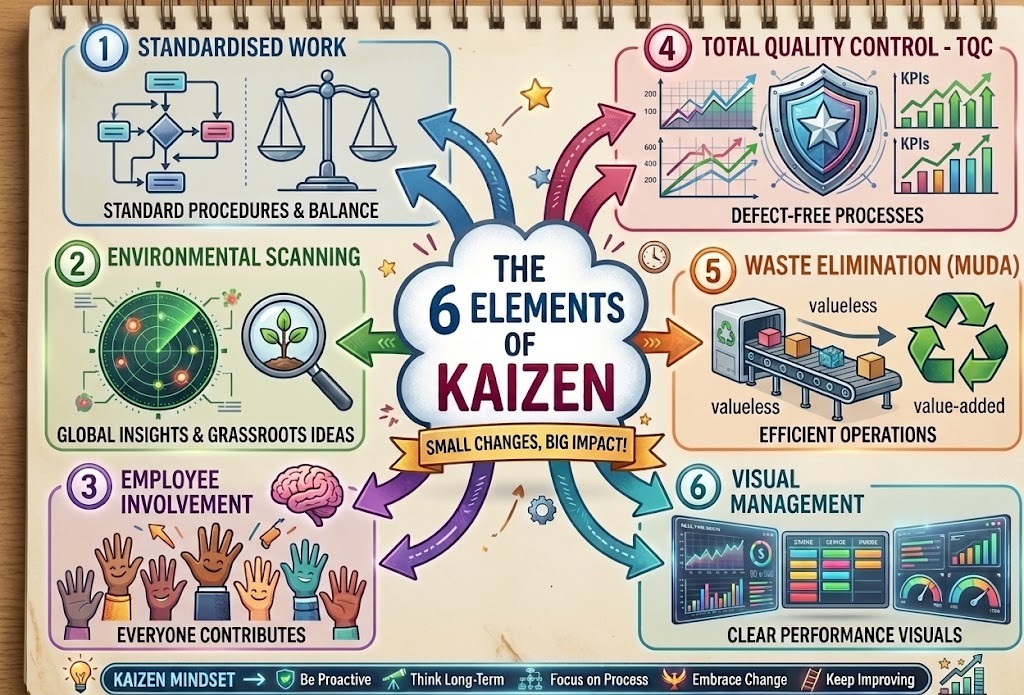
Our AMVEN Improvementors graphic, sets out six elements of Kaizen: standardised work, environmental scanning, employee involvement, total quality control, waste elimination and visual management. As images go it is pleasant enough. As a checklist it is brutal, because most organisations I walk into, in manufacturing and out of it, have one and a half of the six.
The reason I want to run through them here rather than nod at them is that they are not six good ideas of which you might pick your favourites. They interlock and connect. Take any two away and the other four stop working, which is a reasonable description of why your events do not stick.
Standardised work, or why there is nothing to improve
Without a standard there is nothing to improve, only opinion. This is the first element for a reason, and it is the one that collapses fastest outside a factory or office.
On a production line the standard is at least visible: there is a way the job is done, it is written down somewhere, and a deviation can be seen. In project and knowledge work the standard is usually a fiction maintained by a methodology document nobody has opened since onboarding. Every project manager runs the plan their own way. The lessons learned log is written on the final Friday afternoon, filed in a SharePoint folder with a name only its author remembers, and read by precisely nobody. The next project starts from a blank template and the same people make the same mistakes in a different order, which everyone experiences as bad luck.
If you cannot say how the work is currently done, any improvement you make is unmeasurable and unsustainable. You have fallen victim to the Kaizen Fallacy. You are not improving. You are redecorating.
Environmental scanning, or the annual offsite problem
The element is continuous small adjustment as conditions move. The British corporate translation is the annual strategy offsite: one large correction every twelve months, usually in a hotel near an airport, followed by eleven months of drift.
This is an arithmetic point more than a philosophical one. A system that corrects once a year accumulates a year of error before anyone touches it, and the correction then has to be violent, which is why transformation programmes feel like transformation programmes. A system that corrects weekly never accumulates enough error to need a programme at all. The offsite is not wrong. It is just running at roughly one fiftieth of the necessary frequency.
Employee involvement, or why they stopped telling you
Every level contributes. The modern version is an ideas portal with a launch email, a poster in the kitchen and then silence.
I want to be blunt about the mechanism here, because it is not apathy. The people who know where the work breaks are the people doing it. They have almost always told somebody already, usually more than once, often years ago. Nothing happened. No explanation was given. And the rational conclusion from that experience is that raising things costs you time and produces nothing, so they stopped, and their silence is now read upstairs as engagement being a bit low this quarter.
The eighth waste, the underuse of people’s skills, is not really about skills. It is about the difference between being asked and being heard. You can restart this, but not with a portal. It restarts when somebody raises something small, it gets fixed within a fortnight, and the person who raised it is told it was fixed and why. Do that six times and you will have more ideas than you can process. Do it once and announce a culture change programme and you will have nothing.
Total quality control, or hope and a deadline
Quality prevented rather than inspected. The manufacturing version of this argument was settled decades ago and I am not going to regurgitate it.
The office version has barely started. If you cannot tell me roughly what proportion of your team’s output has to be redone because the input was wrong, incomplete or late, you do not have quality control. You have hope and a deadline. In most of the finance, legal, HR and delivery functions I have worked in, rework runs somewhere north of a fifth of total effort and nobody counts it, because it does not look like rework. It looks like chasing, clarifying, going back to the requester, and sitting in a meeting to align. It is all rework, and it is all caused by a defect somebody upstream did not know they had shipped.
Waste elimination – with a warning attached
I have previously written about the eight wastes and how few senior people can name them past number four, so I will not repeat that here beyond the link ([LINK: Saying ‘Lean’ Is Not a Skill]).
What is worth adding in a Kaizen context is that waste removal is the fifth element, not the first. It sits after standardisation, after observation, after the people doing the work have been asked. Removing waste you have not understood is not Kaizen. It is cost-cutting with better branding, and it has a habit of deleting the informal inspection step that was quietly holding the process together.
Visual management, and the board that faces the wrong way
Charts, boards, signs. Easily the most misunderstood of the six in office environments, because almost everyone believes they already have it.
Believing a digital reporting tool solves your problems is another symptom of the Kaizen Fallacy. A Jira board is not visual management if its purpose is reporting status upwards. Visual management makes an abnormality obvious to the people doing the work, at the moment it happens, without anyone having to ask. That is the whole test. Does the board tell the team something is wrong right now, in time to do something about it? Or does it tell the steering committee how things went?
Most digital boards are the second thing. They are instrumentation for management, pointed away from the work. The clue is usually that somebody has to update it before the meeting, which means it was not telling anybody anything until the meeting was imminent.
The mindset strip, and the British problem
Along the bottom of our diagram runs the mindset: be proactive, think long-term, focus on process, embrace change, keep improving. The sort of list that is easy to skim past.
Think long-term is the one that quietly kills Kaizen in this country, and it is not a character flaw in British managers. It is a structural consequence of how we organise. Kaizen assumes you will still be here in three years, and so will the process owner, and so will the standard. UK organisations reorganise on something like an eighteen-month cycle, directors tend to move roles before the gains from anything slow have landed, and the promotion goes to the person with a visible programme rather than the person whose area quietly stopped having problems.
In that environment, the three-day event with the storyboard and the photograph is not laziness. It is the rational response to the incentives. Anyone advising you to think long-term without addressing the tenure and recognition problem is selling you a poster.
Which is also the honest answer to why so many Kaizen programmes fail here. Not because people do not understand the tools. Because the system they sit inside rewards visible activity on a twelve-month clock and Kaizen pays out on a three-year one.

Three things worth doing as soon as you can.
First, pick one process and find out whether a standard exists. Not whether a procedure document exists, which it will. Ask three people who do the work to describe how they do it, separately, and then compare. If you get three different answers, you have found why your last improvement did not stick, and it will have taken you no more than an hour.
Second, go back to the last improvement event your organisation ran and establish whether the change is still in place. Not whether the benefit was reported. Whether the thing is still being done. This is a two-hour job and it is the single most useful diagnostic in this whole article, which is why almost nobody does it: the answer is usually no, and having the answer creates an obligation.
Third, fix something small that somebody told you about, and tell them you fixed it. That is the entire exercise. It is worth more to employee involvement than any portal, survey or engagement initiative you will be sold this year.
Kaizen was never the event.
It was never the brown paper either. Avoiding the Kaizen Fallacy means focusing on the unglamorous business of making the work slightly better this week than it was last week, in a way that is still true next year.
She’s booked another one for November!
Frequently asked questions
What are the six elements of Kaizen?
- Standardised work
- Environmental scanning
- Employee involvement
- Total quality control
- Waste elimination
- Visual management
They are interdependent rather than optional: without a standard there is nothing to improve against, and without visual management a deviation from the standard is invisible until it reaches a report.
Does Kaizen work in office and knowledge work environments?
Yes, but the elements have to be translated rather than transplanted. The standard is a way of working rather than a cycle time, visual management means making abnormalities visible to the team rather than reporting status upwards, and inventory sits in inboxes and ticket queues rather than on racking.
Why do Kaizen events fail to deliver lasting improvement?
Usually because the event is the whole system rather than part of one. Without standardised work the change has nothing to hold it, without visual management nobody sees it drift, and without stable process ownership there is no one accountable when it does. Most organisations can show the storyboard and cannot show the standard.