

Operational Excellence in 2026: Why Bespoke Beats Every Template
31 March 2026
UK AI Investment 2026: Why the £500 Million Sovereign Fund is Only the Beginning
18 April 2026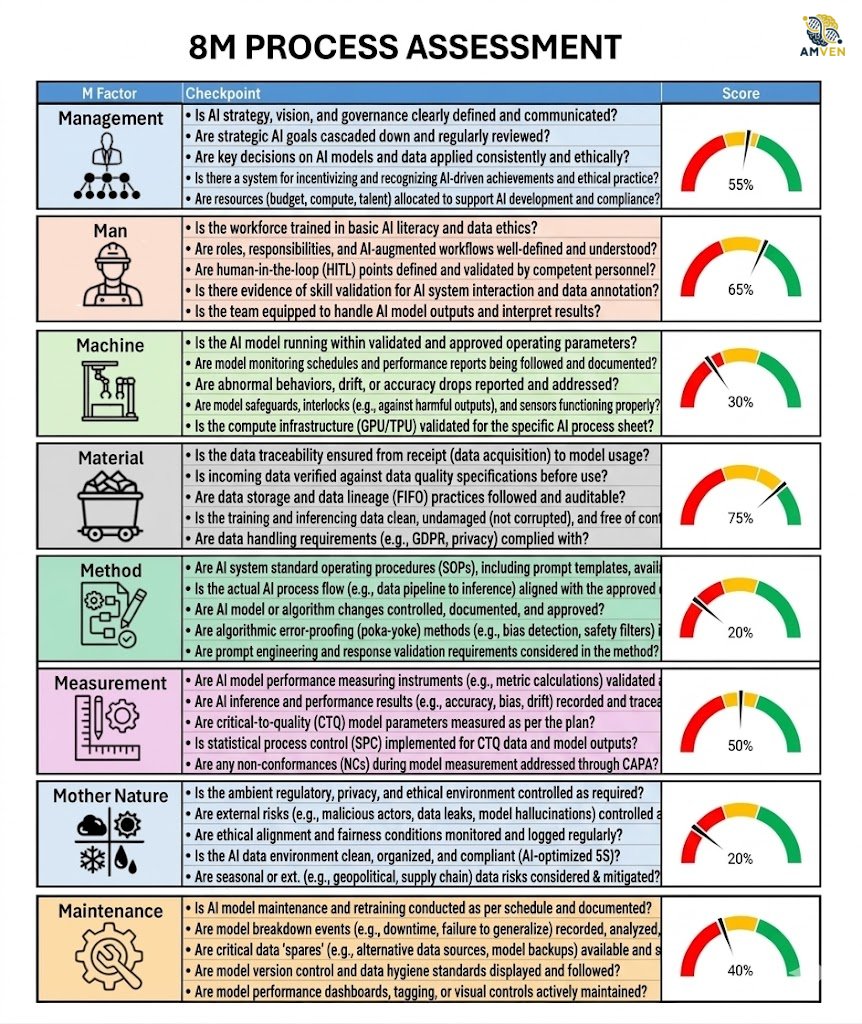

The 8M Framework: Building the DNA of AI & Automation Readiness
The Hidden Prerequisite for AI Success
Many digital transformation projects fail not because the technology is flawed, but because the underlying processes are unstable. In 2026, as UK and European firms race to integrate autonomous agents and predictive analytics, the 8M framework has emerged as the critical “sanity check” for AI readiness.
Does your business actually need AI, or does it just need better process control?
The 8M methodology provides a structured assessment of Management, Man, Machine, Material, Method, Measurement, Mother Nature, and Maintenance. By addressing these eight pillars, organisations create the clean, structured, and predictable environment that AI requires to deliver measurable ROI. Without this foundation, AI merely accelerates existing inefficiencies.
The Evolution of Excellence: From 4M to 8M
The roots of this methodology lie in the Toyota Production System (TPS) and the work of Kaoru Ishikawa. Originally conceived as the “4M” framework (Man, Machine, Material, Method), it was designed to identify the root causes of production defects.
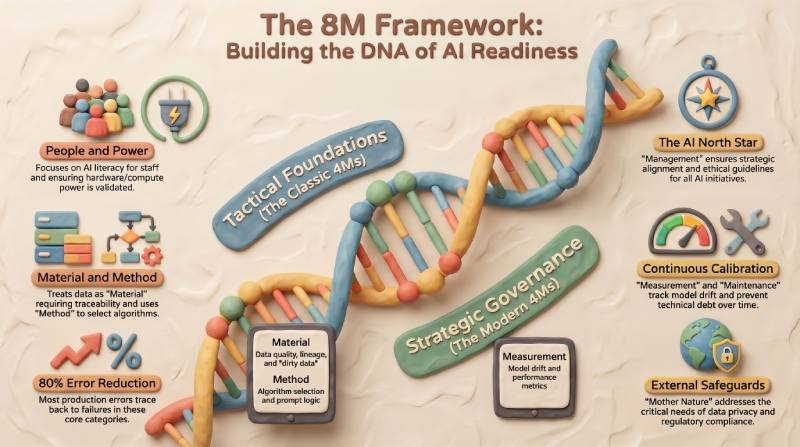
As global supply chains grew more complex and technology more integrated, the 4M model became insufficient. The modern 8M framework adds four critical dimensions:
- Management: Leadership, strategic alignment, and resource allocation.
- Measurement: Data integrity, calibration, and traceability.
- Mother Nature (Environment): External risks, ambient conditions, and sustainability.
- Maintenance: The shift from reactive repairs to predictive and autonomous upkeep.
Why 8M is Superior to Modern Competitors
While frameworks like Six Sigma or Total Quality Management (TQM) offer high-level philosophies, 8M is a granular, tactical tool.
- Compared to 5S: While 5S focuses on workplace organisation, 8M addresses the systemic inputs of the entire process.
- Compared to OEE (Overall Equipment Effectiveness): OEE measures performance; 8M identifies why that performance is lagging.
The primary advantage of 8M is its ability to conduct a Root Cause Analysis. Research suggests that nearly 80% of production errors can be traced back to a failure in one of these eight categories. By using a standardised checklist, leaders move from “guessing” to “knowing.”
The 8M Framework: A Modern Breakdown
| M Factor | Focus Area | AI Context |
| Management | Strategic goals and resource allocation | Defining the AI North Star and ethics |
| Man | Skill validation and competency | Human-in-the-loop and AI literacy |
| Machine | Validated parameters and interlocks | Compute power and hardware health |
| Material | Traceability and FIFO practices | Data quality, lineage, and “dirty data” |
| Method | SOPs and error-proofing (Poka-Yoke) | Algorithm selection and prompt logic |
| Measurement | Calibration and SPC | Model drift and performance metrics |
| Mother Nature | Environmental and seasonal risks | Data privacy and regulatory compliance |
| Maintenance | Predictive and TPM boards | Technical debt and model retraining |
Why 8M is the DNA of AI Readiness
AI is a “garbage in, garbage out” system. If your “Material” (in this case, data) is contaminated or your “Measurement” (data collection) is uncalibrated, your AI outputs will contain hallucinations or errors.
At AMVEN, we view the 8M framework as the ultimate data-cleansing tool. For a UK SME to successfully deploy an AI Solution, they must first ensure their physical and procedural inputs are stable.
Key Takeaways for Senior Leaders:
- Stabilise before you Automate: Use the 8M checklist to identify process gaps before introducing AI tools.
- Data as Material: Treat your business data with the same traceability and FIFO (First-In, First-Out) rigor as raw physical materials.
- Maintenance is Non-Negotiable: Modern AI requires “Model Maintenance” to prevent performance decay over time.
Sector Application: Beyond the Shop Floor
While born in manufacturing, 8M is now being utilised across:
- Logistics: Managing “Mother Nature” (weather/traffic) and “Machine” (fleet health).
- Healthcare: Ensuring “Man” (staff training) and “Method” (clinical SOPs) are aligned for AI-assisted diagnostics.
- Financial Services: Using “Measurement” and “Management” to oversee algorithmic trading and risk assessment.
Conclusion
Operational excellence is not a destination; it is a state of readiness. The 8M framework provides the discipline required to turn “potential” into “performance.” As we move deeper into the AI era, the companies that thrive will be those that didn’t forget the fundamentals.
If you are unsure whether your processes are stable enough to support an AI and/or Automation investment, book a discovery session with AMVEN to conduct a high-level 8M assessment.
FAQ: 8M and AI Integration
What is the difference between 4M and 8M?
The 4M framework is the classic model focusing on Man, Machine, Material, and Method. The 8M model expands this to include Management, Measurement, Mother Nature, and Maintenance, providing a more comprehensive view of modern business complexities and data requirements.
How does 8M help with AI implementation?
AI requires high-quality, consistent data to function. The 8M framework ensures that the processes generating that data are stable and calibrated. For example, if your “Measurement” pillar is weak, your AI will be trained on inaccurate information.
Is 8M only for manufacturing?
No. While it originated in the Toyota Production System, 8M is a universal process-control tool. It is effectively used in logistics, professional services, and software development to ensure operational discipline.
Who should own the 8M assessment in a company?
While the CEO sets the vision (Management), the 8M assessment should be a cross-functional effort. In an AI-forward company, this often falls under the remit of a Fractional CAIO or a Head of Operations or Head Of Operational Excellence.
How often should an 8M audit be conducted?
It should be a living document. High-performing organisations conduct mini-audits monthly and comprehensive reviews annually or whenever a major process change (like an AI rollout) occurs.
Author Bio
Andy McGurk is a Fractional Chief AI Officer (CAIO) and the founder of AMVEN. With over two decades of experience in operational excellence and technology leadership, he helps UK and European businesses bridge the gap between traditional process discipline and cutting-edge AI strategy. Connect with Andy on LinkedIn.
