

Why Your Prompt-a-thon Isn’t Working (and What Will)
20 June 2026
AI Models Broke Into Four Real Companies During Safety Testing. Nobody Audits the Test Lab.
2 August 2026The EU Just Ordered Google to Open Android to Rival AI Assistants: What UK Businesses Need to Know

The EU Just Ordered Google to Open Android to Rival AI Assistants: What UK Businesses Need to Know
What the Commission actually ordered
The Digital Markets Act, for anyone who has not had cause to read it recently, is the EU’s competition law framework aimed at “gatekeepers” – the small handful of platforms whose control of digital infrastructure gives them the ability to distort markets in ways ordinary competition law struggles to reach. Google, unsurprisingly, is one of them. The Commission opened two specification proceedings against Google in January 2026, each carrying a six-month statutory deadline. Both concluded on the same day, Thursday, with binding orders.
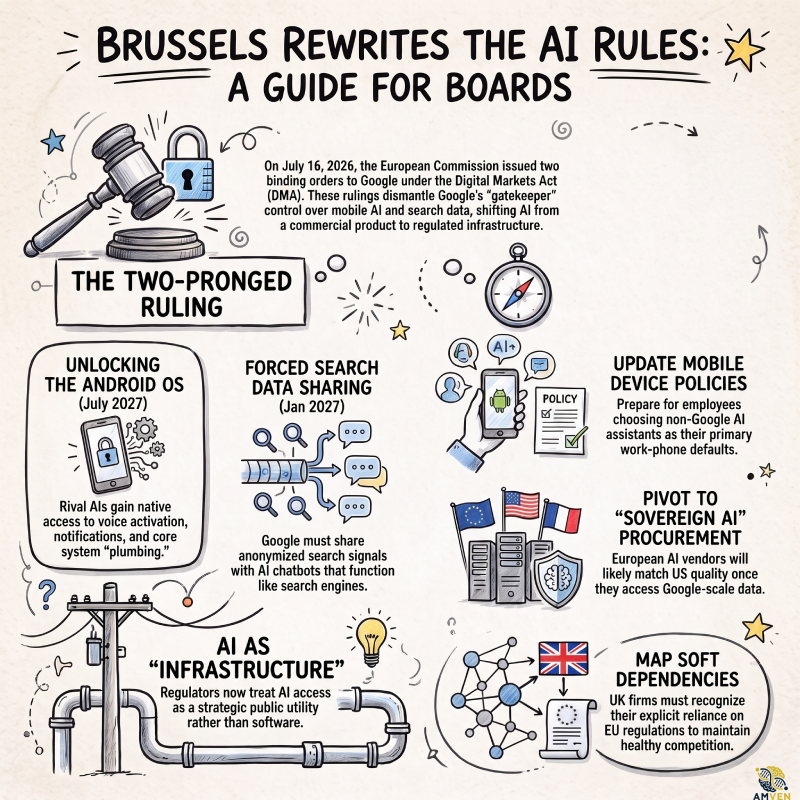
The first ruling opens eleven features of the Android operating system to rival AI assistants. Until Thursday, these features had been reserved, quietly and without much fanfare, for Google’s own products – most notably Gemini. From July 2027, when the next major version of Android ships, competing AI assistants from OpenAI, Anthropic, Mistral, Perplexity and anyone else who can meet the security and privacy requirements will be able to plug into the same operating-system-level hooks. Voice activation from the home screen. Access to the notification tray. Integration with the accessibility APIs. The intent-handling system. All the plumbing that has quietly made Gemini feel native on Android while every rival AI felt like an installed app.
The second ruling is the one that will matter more in the long run, and it is being talked about less. Google Search holds roughly 95% of the EU search market. The query, click and ranking signals it generates from that scale are the primary training input for anyone building a search system or an AI retrieval system. Rivals cannot replicate that data by building smaller search indexes, because the value of the data is precisely in its scale. Under the new specification, Google must share anonymised versions of that data with third-party search engines – and, in a 2026 reinterpretation of Article 6(11) of the DMA, with AI chatbots that perform functions equivalent to search. That is OpenAI. That is Anthropic. That is Perplexity. That is Mistral. That is, in principle, anyone building a retrieval-based AI system in Europe. Data sharing begins in January 2027.
Teresa Ribera, the Commission’s Executive Vice-President for Clean, Just and Competitive Transition, said the ruling was about “keeping the digital transformation fair” and giving citizens “genuine choice”. Google’s Chief Legal Officer, Kent Walker, responded that the measures “risk undermining vital privacy and security guardrails” and “discount extensive evidence of user harm”. Both are, to some extent, right. The privacy concerns about anonymised-but-large-scale data sharing are not confected. The competition concerns about a 95% market share held by a company that also happens to control the mobile operating system half of Europe uses are also not confected. Which of those two you weight more heavily probably says quite a lot about your priors.
Why this is bigger than “another EU regulation” headline
There is a well-worn story about EU tech regulation that goes something like this: Brussels writes rules, tech companies grumble, everyone adjusts, life goes on. The DMA is different, and this ruling is different within it, for three reasons.
The first is that the ruling directly touches AI market structure at the exact moment the market is forming. The USB-C charging port ruling is often cited as an example of EU regulation eventually working out well for consumers. That analogy is being trotted out this week for the Android ruling, and there is something in it – but USB-C changed how you charge a phone. This ruling changes which AI assistant is competing for your attention at the moment you unlock your phone. That is a different order of consequence.
The second is that the ruling extends the DMA’s data-sharing obligations to AI chatbots for the first time. This is a novel interpretation. Before Thursday, “search” under the DMA meant Google Search, Bing, DuckDuckGo. As of Thursday, it also means Claude when you use its web-search functionality, ChatGPT Search, and Perplexity. That reinterpretation matters because it establishes a regulatory principle – if it functions like search, it is treated like search – which will echo through every future regulatory decision touching AI in Europe.
The third is that this ruling arrives against the backdrop of the June export control incident that took Anthropic’s Fable and Mythos models offline globally with three minutes’ notice. That story was about a US regulator switching off AI access. This story is about an EU regulator forcing AI access open. Together, they establish the direction of travel: national and supranational regulators are now actively shaping the AI market, in different directions and at speed. If you were assuming AI would remain a normal commercial product regulated with a light touch, that assumption was wrong six weeks ago and it is more wrong now.
Three things this changes for a UK CAIO
The UK is not, of course, in the EU any more. The DMA does not apply here. Google can, in theory, run a two-track Android in a way it has not done since Brexit. In practice, Google is extremely unlikely to build a separate Android for the UK alone, so we will almost certainly benefit from the changes anyway. But the fact that our regulator – the Competition and Markets Authority – has been considerably slower to act on this specific question than the EU has is worth noticing. If you are a UK business relying on the EU’s regulatory backbone to keep AI competition healthy in your market, that reliance is now, quietly, explicit. Add it to the list of soft dependencies you have not yet mapped.
Beyond that structural point, three practical things change for UK CAIOs and CIOs in the near term.
Your default mobile AI assumption needs updating. The assumption that “our people use Google Assistant on their Android phones because it is the default” will not hold by mid-2027. The next generation of Android – the one that ships to your employees’ work-issued phones in the second half of 2027 – will let them choose their AI assistant with a voice command. Based on the Windows browser-choice-screen precedent, they will exercise that choice. Which AI assistants are you going to support on work-issued devices? What does your MDM policy look like when there are four possible voice-activated AIs on the same phone? What are your data handling implications when an employee uses Claude on their work phone to summarise a customer email that lives in Microsoft 365? These are conversations to start having now with your device management and information security functions. Nobody has had them yet. The organisations that have them first are going to look considerably more professional than the ones that do not.
Your competitive vendor landscape is about to become more European. The search data sharing provisions genuinely do level the playing field for AI retrieval systems in Europe. If you have been sceptical about whether Mistral, Anthropic’s European operations, or other European players can realistically match American search-augmented AI on quality, watch what happens when they gain access to Google-scale search signals to train against. There is a real chance that by the second half of 2027, the AI capability landscape in Europe looks materially different from the one you are planning against today. Sovereign AI, sovereign infrastructure and sovereign data are no longer abstract policy debates; they are, quite suddenly, procurement categories. Your procurement team should probably be reading the Commission’s specification order, or at least a summary of it, before this quarter’s next vendor selection meeting.
Your data sharing exposure just got more complicated. The Article 6(11) reinterpretation means that AI chatbot providers may soon receive Google search data derived, in part, from queries made by your customers and employees. That data will be anonymised. It will be subject to risk assessments before sharing. It will nonetheless exist. If you are in a heavily regulated sector – financial services, healthcare, defence – you will want to understand your customers’ data journey when they use search-adjacent AI tools, because the journey has changed. If you are not in a heavily regulated sector, you probably still want to understand it, because the customers who care about privacy will be checking.
What this actually tells us about the direction of travel
The overarching pattern of AI in 2026 is that access – who has it, who controls it, on what terms – is becoming the defining question. In April, Anthropic launched Project Glasswing to restrict Mythos access to fifty vetted organisations. In June, the US government told Anthropic to switch off two of its most capable models globally, and Anthropic complied. On Thursday, the EU told Google that it can no longer preferentially wire its own AI into the operating system its customers use.
Three regulators, one vendor, three completely different answers to what the access rules should be. The businesses that come through the next eighteen months best will be the ones that treat access – regulatory access, data access, infrastructure access – as a strategic function rather than an operational afterthought. That means, in practice, a CAIO or CIO who understands the DMA at least as well as their vendor’s Chief Legal Officer, and a strategy function that treats AI market structure as its own discipline rather than as an extension of the existing SaaS procurement process.
Frontier AI is not enterprise software any more. It is infrastructure. And the plumbing of infrastructure – who owns the pipes, who has the keys, who gets to plug in – is now a strategic question, not a technical one. Brussels answered part of that question on Thursday. The answer will reshape which AI touches which pocket for years. Read it while your competitors are still catching up on the summer news.
Is your AI strategy ready for the reality of 2027?
Don’t wait for a vendor pitch or a compliance audit to force your hand. Whether you need to map soft regulatory dependencies, update your device policies, or realign your procurement strategy, AMVEN AI helps executives stay ahead of the curve.
Schedule an Executive AI Briefing with AMVEN
Andy McGurk is a Fractional Chief AI Officer and the founder of AMVEN. He helps UK and European organisations build AI strategies that survive contact with reality. He reads Commission specification orders so you do not have to, and remains quietly amazed at how few UK boards do.
