
Stop Playing Corporate Theatre: The Cognitive Architecture of Decision Making
17 March 2026
Operational Excellence in 2026: Why Bespoke Beats Every Template
31 March 2026The Rhythm of Results: Why Your Change Management Programme is Stalling (and How to Fix It)

The Rhythm of Results: Why Your Change Management Programme is Stalling (and How to Fix It)
In the boardrooms and “leadership team” meetings of the UK and across the wider EU business landscape, ‘Change Management’ has become a ubiquitous term. Yet, for many, it remains a source of profound frustration. It is often treated as a nebulous “soft skill” or a series of ‘town hall’ meetings designed to “get people on board.” At AMVEN, we view it through a different lens: Change Management is a cold, systematic discipline. It is the architectural framework for handling transitions—whether they involve shifting goals, evolving processes, or implementing new technologies.
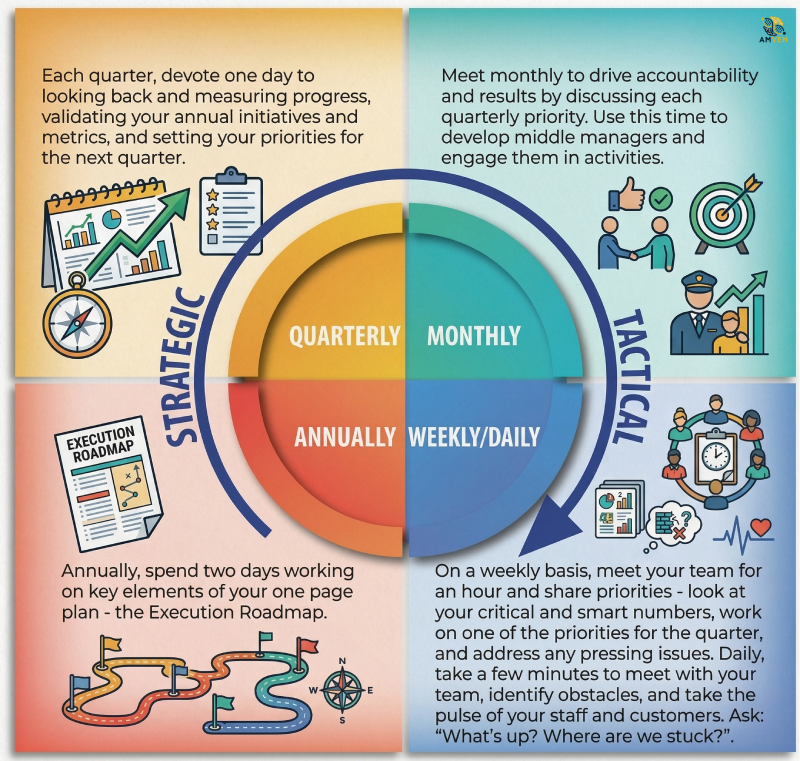
To move from organisational friction to operational fulfilment, a business must adopt a specific cadence. As our updated Execution Roadmap illustrates, this requires a balance between two strategic pillars and two tactical layers. However, the secret isn’t just in knowing these quadrants; it’s in having the discipline to follow the “rules” of the rhythm.
The Strategic Pillars: Looking Over the Horizon
Most businesses fail because they are perpetually reactive. They mistake “busy-ness” for progress. To break this cycle, you must protect your strategic time with a ferocity that borders on the obsessive.
-
Annually: The Execution Roadmap. Once a year, leadership must step away from the “doing” for two full days. The objective? To refine the one-page plan. This isn’t a 50-page binder that gathers dust; it is a living Execution Roadmap. If your strategy cannot be articulated on a single page, it is too complex to be executed. This session is about defining the “North Star” and ensuring every department knows exactly which direction to march.
-
Quarterly: The Course Correction. Every 90 days, you must devote one day to looking back. This isn’t just about celebrating wins; it’s about validating your annual initiatives against hard metrics. Are the “Smart Numbers” moving? If not, why? This quarterly beat allows you to set new priorities for the next sprint, ensuring that the annual plan doesn’t become obsolete by June.
The Tactical Gears: Keeping the Engine Turning
Strategy is useless without a tactical engine to drive it. This is where many leaders drop the ball, either by micromanaging or by disappearing entirely into high-level planning.
-
Monthly: Accountability and Mentorship. The monthly meeting is the bridge. It is designed to drive accountability by discussing quarterly priorities. Crucially, it is the primary venue for developing middle managers. If your middle management isn’t engaged in these activities, your strategy will never reach the frontline.
-
Weekly & Daily: The Pulse. On a weekly basis, teams should meet for no more than one hour to share priorities and address pressing issues. Daily, a ten-minute “stand-up” serves to identify obstacles. The questions are simple: “What’s up? Where are we stuck?”
Why Most Businesses Get the “Rules” Wrong
If the framework is so logical, why do so many organisations struggle? The answer lies in the erosion of these boundaries. When the “rules” are ignored, the culture sours.
1. The “Meeting for the Sake of Meetings” Trap
We see it constantly: calendars cluttered with “Strategic Alignment” or “Check-in” sessions that yield no tangible outcomes. When a meeting lacks a clear output—a decision, a delegated task, or a pivot—it becomes a drain on the company’s lifeblood. Colleagues quickly sense when a meeting is “just another item on the list,” leading to a total lack of valuable input from the very people who need to drive the change.
2. The “Doing” Deficit
In far too many companies there is a growing, palpable feeling amongst colleagues that leaders are “always in meetings.” When executives spend 40 hours a week in back-to-back Teams calls or physical meetings, they lose the capacity to “do the doing.” Leadership is not just about talking about work; it’s about clearing the path so work can happen. A leader who is always meeting is a leader who is unavailable to lead.
3. The Inclusivity Fallacy
In a misguided attempt to “break down silos,” many organisations have started inviting everyone to every meeting. There is a fundamental difference between leading by involvement and leading by total consensus. When you require twenty people to agree on a three-person tactical decision, decision-making slows to a standstill. You aren’t being inclusive; you are being indecisive. This “consensus-creep” kills momentum and frustrates high-performers who just want to get on with the job.
4. The Silence of the Experts
When meetings are poorly structured, the most valuable voices often go silent. If a session feels performative, your best people will stop offering “Smart Numbers” or honest critiques. They become passengers in a process they no longer believe in.
The Solution: A Return to Discipline
Effective change management requires you to respect the silos of time. Strategic time must be purely strategic. Tactical time must be purely tactical. By following the precise rhythms of the AMVEN roadmap, you restore clarity to your organisation. You empower your middle managers, you give your leaders time to actually execute, and you ensure that when you do meet, it actually matters.
It is time to stop pretending that a full calendar is the same thing as a successful strategy. It’s time to find your rhythm.
Is your leadership team’s current meeting cadence slowing down your progress rather than accelerating it? It may be time for a professional intervention. Engage with AMVEN for a targeted Strategic Course Correction. We help leaders in the UK and beyond refine their execution roadmaps and optimise their management rhythms for decisive, impactful action. Contact the AMVEN team today to reclaim your time and your results.
