Why the McKinsey ‘Lilli’ Breach is a Wake-Up Call for UK Boards — And It’s Not Why You Think
11 March 2026
The Rhythm of Results: Why Your Change Management Programme is Stalling (and How to Fix It)
26 March 2026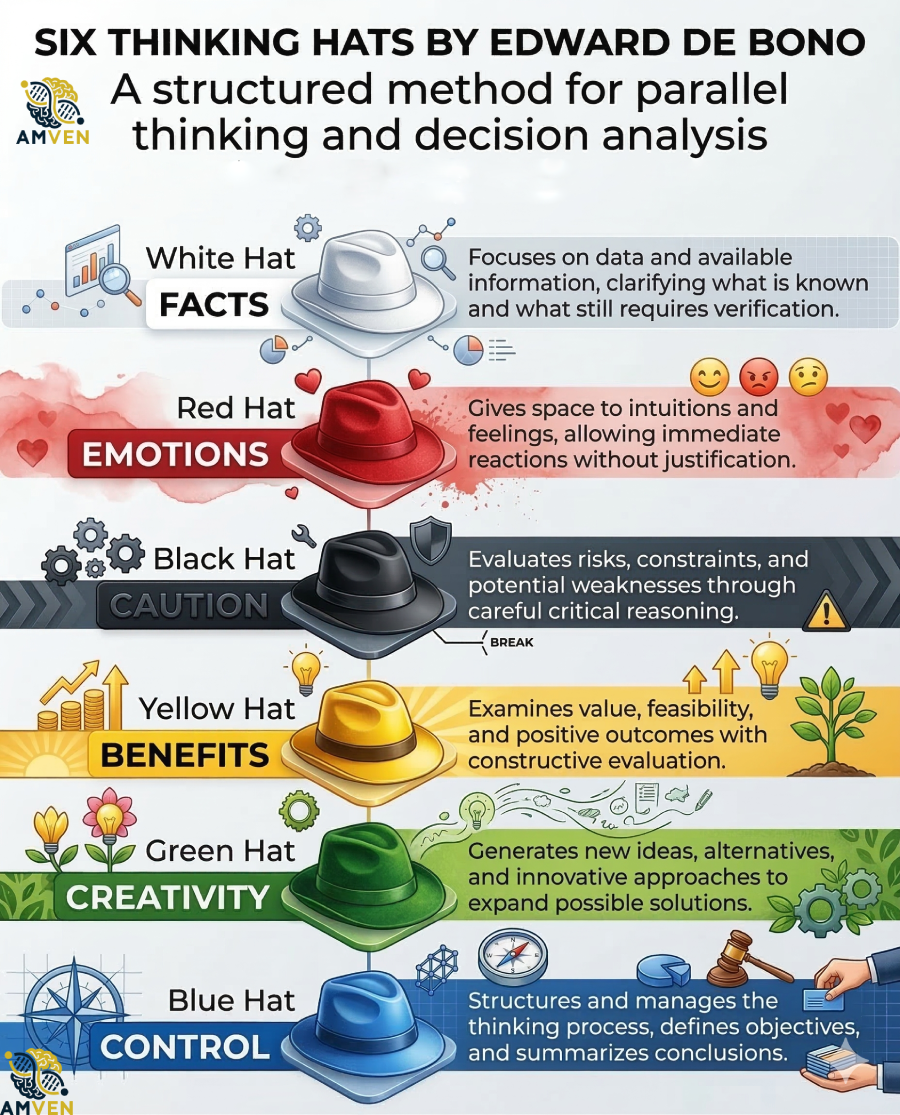

Stop Playing Corporate Theatre: The Cognitive Architecture of Decision Making
Most executive or strategy meetings are an expensive form of performance art.
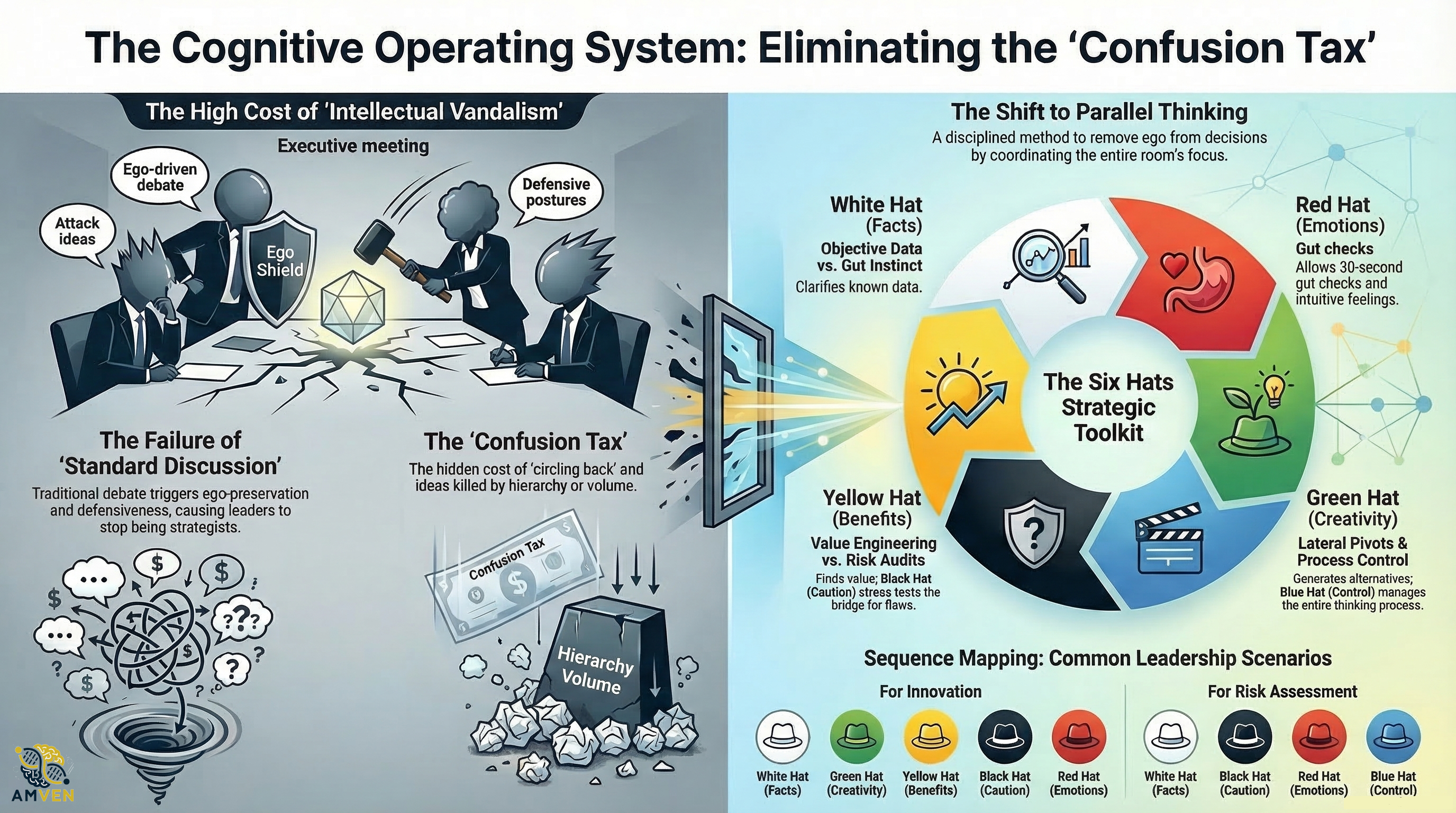
I’ve spent the last decade watching highly promoted people – CEOs, MD’s, technical founders, veteran board members — waste thousands of billable hours in what I call Intellectual Vandalism. That’s when someone feels a need to destroy another person’s idea, not because it’s wrong, but because being the person who spotted the flaw is safer than being the person who championed the idea.
We dress it up as rigorous debate. It isn’t. It’s ego-preservation in business wear.
If you’re running or even contribute to running a high-stakes organisation in 2026, you don’t have time for that. You need a cognitive operating system that actually produces results. Which brings me back to something most people dismissed after a half-day HR workshop: Edward de Bono’s Six Thinking Hats.
Strip away the coloured graphics. This isn’t about psychological safety or making everyone feel heard. It’s about parallel thinking — a disciplined way to remove ego from a decision and leave only the strategy.
Why the Standard “Discussion” Model Fails
Western business culture is built on the Socratic method. You argue for A, I argue for B, truth emerges from the wreckage. In a courtroom, that works. In a meeting with leaders, it’s a disaster.
Think about your last improtant meeting. You propose a new market entry and your CFO immediately flags the regulatory exposure. Your brain doesn’t process that as helpful input; it processes it as an attack. From that point on, you aren’t exploring the idea anymore, you’re defending territory. You’ve stopped being a strategist and started being a politician.
De Bono understood that the brain genuinely cannot run multiple cognitive tracks at once. You can’t be generative while being cautious. You can’t be objective while you’re emotionally invested. The Hats force the entire room to look in the same direction at the same time. It’s the difference between an argument and a coordinated analysis.
Establishing the Ground Truth (White Hat)
This is where most teams fail before they’ve even started. White Hat is strictly about information. What does the data actually say? Not what the trendline implies, not what we’re hoping for – what does the CRM actually say right now?
Opinions offered here are out of order. We’re naming what we don’t know. If the data is missing, we stop and go find it rather than proceeding on assumption.
Red Hat: Permission to be Irrational
Too many business cultures emphasise rational performance. But experienced leaders have instincts built from decades of pattern recognition. Suppressing those instincts doesn’t eliminate them – It just drives them underground, where they resort to obstructionism.
The Red Hat gives someone 30 seconds to say “I hate this deal, it feels like a trap” without needing to build a case for it. Once it’s said, it’s a data point. We don’t debate the feeling, we log it and move on. The alternative is watching that unspoken gut feeling quietly sabotage a project for months.
Stress-testing the bridge (Black Hat)
The most overused mode in corporate life, and the one most people are naturally defaulting to without structure. Black Hat is “why this won’t work” — the risks, the legal exposure, the logical flaws.
The difference between Black Hat thinking and standard scepticism is that here it’s a tool, not a weapon. We’re not attacking the person who proposed the idea. We’re stress-testing whether the bridge holds weight before we drive the bus across it.
The Yellow Hat: A Disciplined Search for Value
This one is hardest for experienced ‘leaders’ because it feels uncomfortably like optimism. It isn’t. It’s a disciplined search for value, even in a proposal that looks like a train wreck. Especially in a proposal that looks like a disaster waiting to happen.
Yellow Hat forces the cynics in the room to look for what would have to be true for this to work, and what the upside looks like if it does. That’s where pivot points come from. You don’t find them by writing off the whole idea at first contact.
Lateral Provocation (Green Hat)
Not “what’s the right answer” but “what are the different answers.” What if we did the exact opposite of our competitors? What if the product isn’t the product?
The reason this needs its own protected phase is that without it, the Black Hat kills ideas before they’re fully formed. Green Hat creates the conditions for an idea to exist long enough to be properly evaluated.
The Conductor (Blue Hat)
Blue Hat doesn’t think about the subject. It thinks about the thinking. Who’s running the room, setting the sequence, calling time. In practice this is usually the chair or lead consultant.
Most executive sessions spiral into circular arguments because nobody is managing the process — everyone is too busy managing their position. Blue Hat is the discipline that prevents that.
When This Becomes a Competitive Advantage
We don’t use this for routine status meetings. That would be overkill. We deploy it when cognitive load is highest and the stakes of a bad decision are significant.
A recent client was ready to scrap a £1,000,000 AI implementation. The meeting had turned into a blame session — tech teams pointing at sales, sales pointing at the brief. We stepped in, called Blue Hat, and structured it.
White Hat revealed the AI itself wasn’t failing; the data quality from the sales team was the issue. Yellow Hat found that the 10% of the pilot that did work had already saved 410 hours of ‘grunt work’. Black Hat established that fixing the data cost less than abandonment.
They left with an actionable roadmap to scale the thing they’d walked in ready to kill.
M&A is another pressure cooker for this. When two companies merge, the emotional temperature is high — people are scared for their jobs, their teams, their relevance. Ignore that and it surfaces as Black Hat obstructionism later. Run a Red Hat session early, let people say what they’re actually feeling, and you create the conditions where the White Hat work can actually land.
The Confusion Tax
If you don’t use a framework like this, you pay what I call a confusion tax. Every meeting that ends with those awful words “let’s circle back” is the tax. Whenever a great idea is shouted down by hierarchy or volume, the company pays a heavy tax in lost potential. Every product you shipped knowing it had flaws, but nobody had a safe way to raise them – that’s the tax.
This isn’t about running ‘nicer’ meetings. It’s about building a room where the best ideas actually survive long enough to be acted on.
Your job as a leader isn’t to have all the ideas. It’s to create the conditions where the best ideas win. If your current meeting structure is just a series of ego contests, you’re not leading. You’re spectating.
Stop letting your most expensive assets—your leaders—waste their brilliance on corporate theatre.
If your strategy sessions feel like a series of “ego contests” or end in the dreaded “circle back,” you aren’t just losing time; you’re paying a massive confusion tax.
At AMVEN Consulting, we help high-stakes organisations install the cognitive operating system they need to move at the speed of 2026. We don’t just “facilitate meetings”—we strip away the intellectual vandalism and replace it with high-velocity parallel thinking. Take a look at how we do this by downloading our Slidedeck here.
Ready to turn your Leadership meetings from a battleground or silent time wast into a strategy engine?
Book a consultation with AMVEN today. Let’s build a room where the best ideas actually win.