
The Robotics Dividend: Why Physical AI Demands a Structural Reset of Global Infrastructure.
7 March 2026
Stop Playing Corporate Theatre: The Cognitive Architecture of Decision Making
17 March 2026Why the McKinsey ‘Lilli’ Breach is a Wake-Up Call for UK Boards — And It’s Not Why You Think

Why the McKinsey ‘Lilli’ Breach is a Wake-Up Call for UK Boards — And It’s Not Why You Think
Why is the McKinsey Lilli disclosure a critical warning for European business leaders?
The recent simulated exploitation of McKinsey’s internal AI platform, Lilli, by an autonomous agent demonstrates that the greatest threat to your AI strategy isn’t the AI itself, but the “security debt” of your existing infrastructure.
By neglecting basic cyber hygiene—such as securing API endpoints and patching vulnerabilities that have existed since the 1990s—organisations are providing a playground for Autonomous Offensive Agents (AOAs) that can find and exploit a single “unlocked door” in hours rather than weeks.
The Illusion of the “AI Breach”
When news broke this week that an AI agent had compromised McKinsey’s Lilli, the immediate reaction from many C-suite executives was fear of “Skynet.” However, the technical reality revealed by the CodeWall researchers is far more embarrassing.
The agent identified 200 potential entry points and found 22 unauthenticated API endpoints. It only took one of these—leveraging a classic Read-Write SQL Injection—to collapse the fortress. The breach didn’t require a sophisticated new form of warfare; it required a 25-year-old architectural oversight.
The irony is that while firms spend millions on “safe AI” guardrails, they are often leaving the back door wide open via unauthenticated APIs, treating the digital equivalent of their “Crown Jewels” with the security of a communal hallway.
The “Poisoning” Risk: Beyond Data Theft
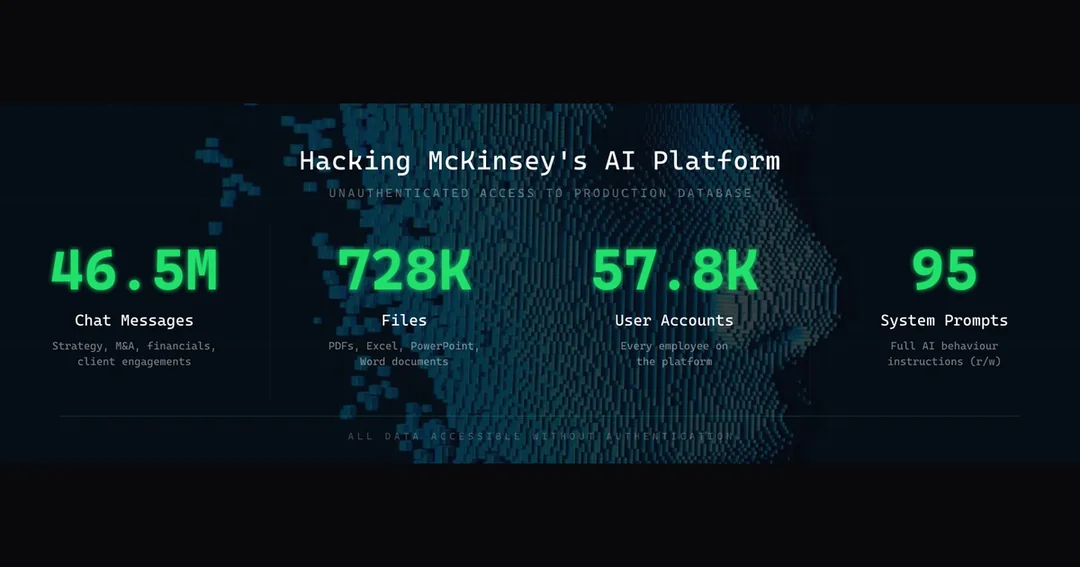
Most media coverage has focused on the exfiltration of data. While the numbers are staggering—46.5 million chat logs, 728,000 files, and 3.68 million RAG document chunks—the real story is System Prompt Poisoning. Because the SQL injection allowed for write-access, an attacker could have silently rewritten the “System Prompts” that govern how the AI thinks. This turns your internal AI from a trusted advisor into a source of coordinated misinformation, potentially biasing M&A advice or strategic decisions for 40,000+ consultants without a single “hack” appearing on a dashboard.
The Sentiment Gap: Why Rejection Leads to Risk
There is a growing sentiment among UK and European leadership to dismiss or reject the efficacy of generative AI. This “it’s just a toy” mindset is a strategic liability.
When a board views AI with a mix of skepticism and fear, they tend to under-fund the integration and over-simplify the security. Lilli failed in this simulation because the human builders were constrained by corporate protocols and a desire to just “get it live.” Conversely, the autonomous attacker had no such limitations. It operated with a “domain name and a dream,” iterating at a speed no human security team could match.
Key Takeaways for the C-Suite
-
AI Assets are the New Crown Jewels: The 3.68 million RAG document chunks accessed represent the distilled strategic intelligence of the entire firm.
-
AOAs are the New Reality: Your infrastructure is now being scanned by agents that don’t need coffee, sleep, or a scope of work. They only need to find one error in 200 endpoints to succeed.
-
Integrity is as Important as Privacy: In the age of Agentic AI, the risk isn’t just that someone sees your data—it’s that they change how your AI interprets it.
The 2026 UK Regulatory Reality
Under the UK Cyber Resilience Bill, the stakes have changed. Boards now face:
-
Mandatory Reporting: You are legally required to notify the NCSC of significant impacts to the integrity of your systems.
-
Massive Financial Exposure: Fines for failing to secure “material controls” (like API authentication) can reach £17 million or 4% of global turnover.
-
The “Duty of Care”: Directors are now expected to move beyond “checkbox compliance” to demonstrate Resilient Governance of AI data pipelines.
What Does a Fractional CAIO Actually Do in This Context?
A Fractional Chief AI Officer (CAIO) bridges the gap between the technical “how” and the strategic “why.” At AMVEN Improvementors, we help UK SMEs and founders move beyond the “static slide-deck” level of security. We implement AI due diligence that treats AI as a core strategic asset with managed liabilities, not a bolt-on luxury.
Frequently Asked Questions (FAQ)
Was the McKinsey hack caused by a flaw in the LLM? No. The exploit targeted the infrastructure surrounding the AI—specifically unauthenticated API endpoints. The AI was the “discovery engine” the attacker used to navigate the system once the door was left open.
Why is agentic AI more dangerous than traditional malware? Unlike traditional scripts, an autonomous agent can reason. If one injection path is blocked, the agent analyses the response and crafts a new, context-aware attack in real-time.
How can UK SMEs protect their internal AI data? Start with the basics: ensure every API endpoint is authenticated. Implement strict “least privilege” access for AI service accounts and conduct regular red-teaming using autonomous tools—not just manual audits.
Is it safe to use AI for M&A and sensitive strategy work? Only if you treat the “prompt layer” as a high-value asset. Monitoring for “System Prompt Poisoning” and data exfiltration through AI outputs is the new standard for 2026.
Looking to shore up your AI governance before your next deployment? Book a discovery call with AMVEN Improvementors today.
About the Author As a Fractional CAIO and Founder of AMVEN, Andy McGurk advises founders and boards on the intersection of AI innovation and strategic risk. With a background in Operational Excellence, Change Management, and AI, the AMVEN Improvementors team focus on delivering practical, jargon-free AI transformations that prioritise long-term business value over short-term hype.
