

The AI Tide: Why Modern Leadership is About Design, Not Just Deployment
17 February 2026
Why the McKinsey ‘Lilli’ Breach is a Wake-Up Call for UK Boards — And It’s Not Why You Think
11 March 2026The Robotics Dividend: Why Physical AI Demands a Structural Reset of Global Infrastructure.

The Robotics Dividend: Why Physical AI Demands a Structural Reset of Global Infrastructure.
We have spent the last decade perfecting a highly centralized, latency-tolerant cloud architecture built for software, streaming media, and early language models. That infrastructure is now functionally obsolete. As we move into 2026, the robotics revolution—long predicted by economists—is deploying across factories, logistics hubs, and service sectors at scale.
To capture the “robotics dividend”—the massive productivity boost needed to offset economic stagnation in aging populations—infrastructure leaders must execute a total structural reset of their network, compute, and governance models.
What is Physical AI? From Tokens to Tensors
The debate regarding Physical AI vs. Generative AI comes down to data physics. In generative AI, the primary unit is the token. Text data is lightweight and static. However, Physical AI operates on tensors derived from continuous, high-frequency multimodal sensor streams.
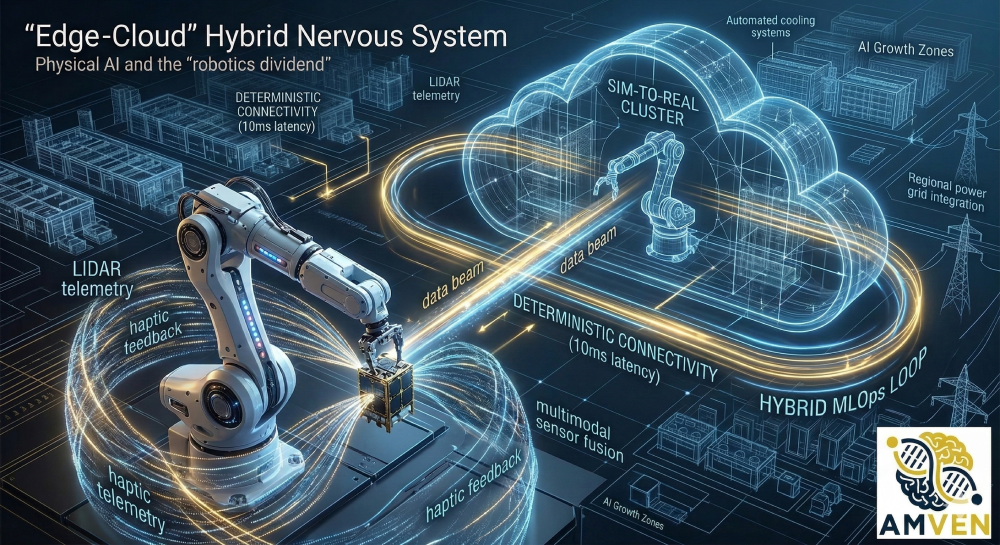
A robotic system navigating a dynamic warehouse relies on LiDAR point clouds, haptic feedback, and spatial telemetry. Existing cloud platforms designed for object storage often collapse under these noisy, time-sensitive streams. In robotics, the bottleneck is rarely the neural network size; it is data movement. In many cases, the transit cost of these vast data volumes now eclipses the cost of storing them.
The Cloud-Edge Loop and Sim-to-Real Training
Collecting kinetic training data in the real world is agonizingly slow. Consequently, the industry relies on Sim-to-Real (Simulation to Reality) training. Teams orchestrate massive virtual environments to generate synthetic data, allowing systems to learn through millions of edge cases before physical deployment.
This creates a paradox: we need colossal cloud clusters for backend simulation, but physical safety dictates millisecond-level responsiveness (under 10ms) for deployed units. The only viable solution is Edge-Cloud Hybridity, pairing the cloud’s “strategic brain” with a low-latency edge compute layer acting as the autonomous nervous system.
The Network Wall: The Shift to Deterministic Connectivity
This hybrid architecture places an unprecedented burden on telecommunications. We are seeing a shift from human-to-machine prompts to relentless machine-to-machine (M2M) engagements.
As Nokia Chief Executive Justin Hotard has highlighted, legacy “best-effort” SLAs cannot survive the physical AI supercycle. When an industrial robot executes a high-risk maneuver, standard network slicing is insufficient.
Infrastructure must evolve into Deterministic Connectivity:
-
AI-RAN: Embedding AI traffic control at the Radio Access Network layer.
-
Programmable Engines: Dynamic execution engines that guarantee latency regardless of bursty traffic.
Operationalizing Kinetic Risk and Governance
As AI initiates kinetic movement, failure shifts from “hallucinations” to physical consequences. Governance must be baked into the MLOps pipeline.
-
Tiered Frameworks: High-risk applications must maintain Human-in-the-loop (HITL) oversight.
-
Observability: Systems must trigger automated rollbacks the moment data drift causes a deviation from operational parameters.
The Sustainability Barrier: AI Growth Zones
The carbon footprint of deep learning is a physical limit. In the UK, the AI Opportunities Action Plan recommends creating “AI Growth Zones.” These zones streamline planning approvals and fast-track clean power provision to solve the data center bottleneck.
| Region | Cloud Control (Foreign Hyperscalers) | Targeted AI Chip Integration |
| Europe | ~70% | 100,000+ (EuroHPC goal) |
| UK | ~65% | Sovereign “AI Maker” Strategy |
Geopolitics and Compute Sovereignty
European markets are currently dependent on foreign hyperscalers for 70% of their infrastructure. To mitigate this, the EU’s “AI Continent Action Plan” leverages the EuroHPC Joint Undertaking to build sovereign AI Gigafactories. Similarly, the UK aims to be an “AI maker, not just a taker,” securing domestic frontier capabilities to ensure economic growth isn’t exported.
What Infrastructure Leaders Must Do Now
To survive this structural reset, leaders must take four decisive actions:
-
Re-architect for Edge-Cloud Integration: Build pipelines for continuous, high-bandwidth read/write operations.
-
Demand Deterministic Networks: Move beyond best-effort SLAs to guaranteed millisecond responsiveness.
-
Operationalize Governance: Embed detective controls and automated rollback triggers directly into deployment workflows.
-
Secure Power and Property: Target investments in designated AI Growth Zones where sustainable power is prioritized.
Scale Your Robotics Strategy with a Fractional CAIO
Navigating the transition from digital tokens to physical tensors requires more than just a tech upgrade—it requires a structural reset of your entire leadership strategy.
What is a Fractional CAIO?
A Fractional Chief AI Officer (CAIO) provides your organisation with C-suite expertise in AI governance, infrastructure, and deployment on a part-time or project basis. They bridge the gap between technical complexity and business growth, helping you:
-
Architect edge-cloud hybrid systems tailored to your specific industry.
-
Operationalize kinetic risk and MLOps governance to ensure physical safety.
-
Strategize for compute sovereignty and energy efficiency.
Take the Next Step
Don’t let the “Network Wall” stall your industrial evolution. Contact AMVEN Improvementors today for a no-obligation chat about our Fractional CAIO services and learn how we can help you capture your share of the robotics dividend.
Take a look at what services we offer and book a free session!
or
