

UK AI Investment 2026: Why the £500 Million Sovereign Fund is Only the Beginning
18 April 2026
How to Modernise the Ohno Circle: A Lean Playbook for the Connected Enterprise
30 May 2026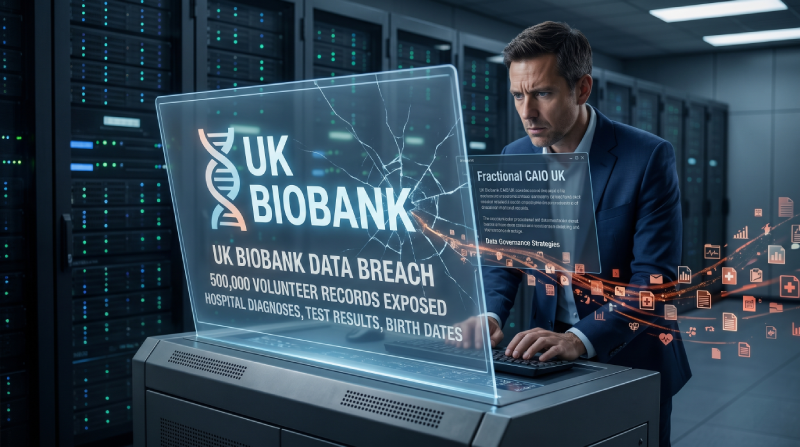

Why the UK Biobank Breach is a Wake-up Call for Governance in 2026
The announcement on 23 April 2026 that 500,000 UK Biobank volunteer records were listed for sale on Alibaba e-commerce platforms is not just a security failure; it is a governance crisis. While the UK Government downplays the impact, claiming no evidence of successful purchases, the reality for technology leaders is stark: the myth of “de-identified” data has officially collapsed.
To protect your organisation, you must stop treating data privacy as a technical tick-box and start treating it as a core architectural requirement. The shift from the accidental GitHub leaks of 2025 to the blatant commercialisation on Alibaba in 2026 proves that “safe” data is only as secure as the weakest link in your research chain.
What is the UK Biobank and why is this breach significant?
UK Biobank is the world’s most comprehensive health resource, tracking the genetic and clinical data of 500,000 volunteers to drive breakthroughs in cancer, dementia, and Parkinson’s. Because it contains deep longitudinal data, it is a primary target for both state actors and commercial entities.
Today’s statement from Technology Minister Ian Murray confirmed that three listings appeared on Chinese marketplaces offering “Biobank participation data.” This follows a pattern of vulnerability that AMVEN has long warned against: the belief that removing names and addresses makes a dataset “anonymous.”
How did the UK Biobank data end up on Alibaba?
Unlike the sophisticated “hacks” often depicted in media, this breach appears to be a failure of distributed governance.
-
Legitimate Access, Illegitimate Storage: The data originated from three research institutions that were granted legitimate access to the Biobank.
-
The Extraction Flaw: Historically, researchers have been permitted to download datasets to private systems for analysis.
-
The Secondary Leak: This mimics the 2025 GitHub crisis, where researchers inadvertently uploaded snippets of data alongside their code. In the 2026 case, this “extracted” data was captured, bundled, and moved to commercial marketplaces.
The government has since revoked access for these institutions and paused all data downloads. But for the 500,000 volunteers, the horse has already bolted.
The “De-identified” Fallacy: Why the Government is Wrong
The government’s primary defence—that the data did not contain names or NHS numbers—is technically true but functionally irrelevant.
In March 2026, a Guardian investigation proved that a volunteer could be pinpointed using only their birth month, year, and a single recorded surgery. When you combine this “de-identified” data with AI-driven cross-referencing of social media and public records, re-identification becomes a trivial task.
Key Takeaway for CEOs: If your AI strategy relies on “de-identified” datasets for training or analysis, you are holding a liability. In 2026, “anonymous” is a temporary state that ends the moment a second dataset is introduced.
Lessons from the 2025 GitHub Leaks vs. Today’s Alibaba Breach
While the 2025 leaks were largely dismissed as “unintentional errors” by researchers, the Alibaba listings represent a move toward the weaponisation of health data.
| Feature | 2025 GitHub Leaks | 2026 Alibaba Listings |
| Intent | Accidental (Code sharing) | Commercial (For-profit sale) |
| Scale | Fragmented snippets | Bulk datasets (up to 500,000 records) |
| Primary Risk | Academic transparency error | Deliberate exploitation |
| Governance Failure | Lack of researcher training | Lack of technical export controls |
The transition from accidents to listings proves that “de-identified” health data now has a specific market value. Your organisation’s data governance must reflect this increased threat level.
What’s the AMVEN approach?
Our Data team bridges the gap between technical compliance and strategic risk. While a DPO might say a dataset is “GDPR compliant” because names are removed, we ask: “Can an AI model re-identify this individual using secondary sources?”
At AMVEN, we advocate for a “Governance by Design” approach. This means:
-
Zero-Export Environments: Data should never leave a secure “Clean Room.” Researchers bring their code to the data; the data never moves to the researcher’s laptop.
-
Automated Egress Filtering: Using AI to scan all outgoing communications and code commits for patterns that resemble participant data.
-
Dynamic De-identification: Applying differential privacy techniques that add mathematical “noise” to data, making re-identification statistically impossible even for AI.
The AMVEN Roadmap for Data Sovereignty
If you are managing sensitive UK or European datasets, you cannot afford to wait for the next ministerial statement.
-
Audit your “Extraction Points”: Identify every instance where data is downloaded from a central repository to a local machine. These are your 2026 vulnerabilities.
-
Move to Trusted Research Environments (TREs): Follow the new UK Biobank mandate. Stop allowing downloads and start providing secure, audited compute spaces.
-
Update Board-Level Risk Registers: Move data breaches from the “IT issue” column to “Existential Business Risk.”
Is your data strategy built on the hope that “nobody bought it yet”? Book a no-obligation discovery call with AMVEN to audit your data governance.
FAQ: UK Biobank and Data Governance 2026
What is the difference between de-identified and anonymous data?
De-identified data has direct identifiers (like names) removed, but the underlying records remain unique. Anonymous data is modified so that the individual can never be re-identified. As the UK Biobank breach shows, de-identified data is often still identifiable through cross-referencing.
How did the 2025 GitHub leaks influence the 2026 Alibaba breach?
The 2025 leaks established that researchers were regularly—and inadvertently—exposing Biobank data. This “leakage” likely provided the raw material or the proof-of-concept for the 2026 commercial listings on Alibaba.
What is a Trusted Research Environment (TRE)?
A TRE is a secure cloud-based platform where data is held. Researchers can log in to perform analysis but cannot download the raw data. This is the “technical solution” the UK Government is now forcing the Biobank to implement.
Are UK SMEs at risk from similar data breaches?
Yes. Any SME that handles “de-identified” customer or medical data for AI training is at risk. If your staff can download your database to their personal devices or public clouds, you have the same structural weakness that led to the Alibaba breach.
Can AI truly re-identify “anonymous” people?
Yes. Modern AI models excel at pattern matching. By joining a “de-identified” medical record with a public LinkedIn profile or voter registry, AI can re-identify individuals with over 95% accuracy in many cases.
