

Why the UK Biobank Breach is a Wake-up Call for Governance in 2026
23 April 2026
Mythos and Fable Just Went Dark. What That Means If You’re Building on AI.
13 June 2026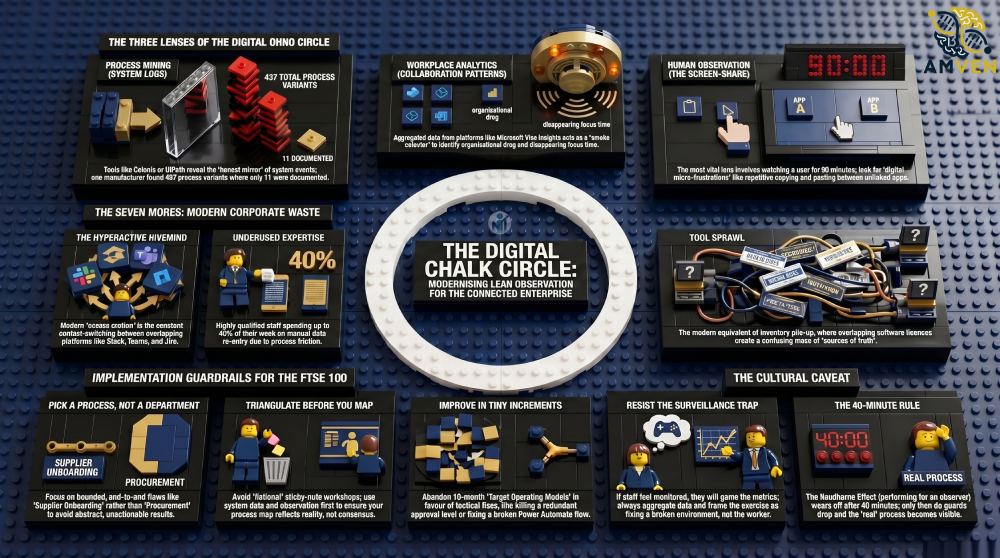

How to Modernise the Ohno Circle: A Lean Playbook for the Connected Enterprise
Putting down the chalk and picking up process mining, Viva Insights and AI
If you tried to draw Taiichi Ohno’s chalk circle on the carpet of a modern London headquarters, three predictable things would happen in quick succession. Someone from Facilities would have it scrubbed off by lunchtime. Someone from Health & Safety would explain why standing in one spot for four hours had raised concerns. And at least one person would hover around eventually politely ask if you’d booked the room. The practice simply doesn’t survive a literal translation into the corporate office.
The underlying idea, on the other hand, has never been more vital.
I’ve spent the better part of two decades helping large organisations – translate factory-floor wisdom into knowledge work. The Ohno Circle is the practice I keep coming back to, and the one most often butchered in the retelling. What follows is my step-by-step playbook for doing this in a fast paced, tech heavy environment: the three lenses to combine, the modern wastes to look for, and the cultural traps that will sink you if you don’t handle them carefully.
A quick reminder of what Ohno actually did
Taiichi Ohno was the production engineer who, more than anyone else, built the Toyota Production System. He had a habit, when training his managers, of drawing a chalk circle on the shop floor and telling them to stand in it. They were to observe — not interrupt, not direct, not check their devices — until they had genuinely seen the process. A morning was the usual sentence. A full day was not unknown.
The trick wasn’t the chalk. The trick was that almost nobody, including the production manager who supposedly ran the line, had ever actually watched the work happen end-to-end. They had reports. They had figures. They had opinions held strongly in steering committees. What they hadn’t done was stand still and look.
Once they did, the waste – the muda – became impossible to ignore: movement that didn’t need to happen, waiting that should have been engineered out, and defects that should have been caught upstream.
The real genius of the exercise was patience. The Hawthorne effect – the urge people have to perform beautifully when they know they’re being watched – wears off after roughly forty minutes. After that, fatigue sets in, guards drop, and you see the real process. And the real process is never, ever the one documented in the standard operating procedure.
Why the practice fails as written
Knowledge work has moved off the floor, meaning the “process” by which a mature company onboards a supplier, closes its books, or approves a marketing brief doesn’t unfold in a physical space. It unfolds across Outlook, Teams, SAP, ServiceNow, half a dozen bespoke applications, three SharePoint sites named almost-but-not-quite the same, and at least one rogue Excel file someone has been emailing around since the Cameron government was in Westminster. Standing in a circle won’t help you see that.
Worse, the action is happening in parallel across distributed, invisible teams. The CFO is approving an invoice in Workday at the exact moment a buyer is chasing a supplier via email, while Finance Ops queries a mismatch in Power BI. No single human can stand in one place and witness this. The chalk circle has been pixelated.
Yet the principle of direct, patient, unmediated observation is still dead right. The question is how we actually execute it today without blinding ourselves.
The Digital Ohno Circle (and its blind spots)
To make this work in a connected enterprise, we have to rely on what I call the Digital Ohno Circle. In an ideal world, this practice relies on combining three distinct lenses. In reality, you rarely get all three at once — legal or tech constraints will usually force you to start with whatever you can get your hands on.
1. Process mining (system logs)
Tools like Celonis, UiPath, or Microsoft’s process insights stitch system event logs back into a picture of the actual process — every step, every detour, every loop. It is an honest mirror.
The first time I ran process mining on an order-to-cash flow at a FTSE-listed manufacturer, the COO discovered there were 437 path variants. The documented version had eleven. One particularly absurd variant showed invoices looping back to a divisional director three separate times just to clear a £5 threshold discrepancy because of a legacy system rule no one remembered writing.
The catch: Process mining has a massive blind spot — it only tracks what happens inside the system log. If a frustrated employee drops out of SAP, opens WhatsApp on their personal phone to resolve a crisis with a supplier, and logs back in an hour later, your expensive software goes completely blind to the actual human problem solving that just occurred.
2. Workplace analytics (collaboration patterns)
Aggregated, anonymised data from tools like Microsoft Viva Insights give you the macro view of organisational drag. Where is meeting load concentrated? Where is focus time disappearing? If your data shows a team’s collaborative work spiking between 8pm and 10pm, it won’t tell you why, but it acts as a smoke detector telling you exactly where to point your circle of vision.
3. Human observation (the screen-share)
This is still the most important lens, but observing over a Teams or Zoom screen-share requires a different discipline than standing on a factory floor. On a shop floor, you can read physical exhaustion or heavy posture. Online, you have to look for “digital micro-frustrations.”
Watch for the user who rapidly copies and pastes the exact same tracking number across four different browser tabs because the applications don’t talk to each other. Watch for the heavy sigh before they open a specific legacy interface.
Pair with them for ninety minutes. Make them narrate what they are doing. Do not help them. Do not suggest a shortcut. Ohno’s discipline of not intervening is the rule that protects the data. Modern consultants tend to break it within ten minutes to show how smart they are; the good ones hold their tongues.
You have to triangulate. Process mining tells you what the system did. Workplace analytics tells you what the organisation did. Observation tells you why the human actually did it.
The wastes, reframed
Ohno’s seven muda survive surprisingly well, but they require translation for the office environment.
The endless context-switching between applications — what Cal Newport calls the “hyperactive hivemind” — is the new excess motion. Approvals that sit in Outlook inboxes for days while value silently drains away are the new waiting. Rework caused by ambiguous, multi-authored briefs is the new defect.
There are also two genuinely new, corporate categories of waste worth naming:
Underused expertise: People with advanced degrees spending 40% of their week doing manual data re-entry because process friction won’t let them do the job they were hired for.
Tool sprawl: The endless proliferation of overlapping platforms (Slack, Teams, Clickup, Jira) that each promise to be the “one true source of truth.” It’s the modern equivalent of inventory pile-up — except the excess inventory is now software licences.
How a Progressive Organisation should actually start
If you want to deploy this without getting bogged down in a multi-million-pound, multi-year failure, keep a few practical guardrails in mind:
Pick a process, not a department. End-to-end matters. “New supplier onboarding” or “month-end close” are tightly bounded and actionable. “Procurement” or “Finance” are black holes that will only generate abstract PowerPoint decks rather than actual improvement.
Triangulate before you map. The conventional approach — convene twenty people in a room and ask them to describe their process on sticky notes — produces the cleanest possible work of fiction. It bears no resemblance to reality. Run your data mining, look at the analytics, conduct three or four screen-share observations, and then draw the map based on reality, not workshop consensus.
Improve in tiny increments. The temptation to completely redesign a “to-be” target operating model over an 18-month timeline kills transformation programmes. Instead, look at the immediate friction. Fix a broken Power Automate flow, kill a redundant approval level, or rewrite a confusing form. Small, tactical interventions change organisational behaviour far faster than massive top-down mandates.
The cultural caveat
There is one piece of all this that nothing in your digital toolkit will solve for you. Workplace analytics and screen-share observations are deeply, genuinely sensitive. At FTSE 100 scale, you will run headfirst into works councils, strict GDPR exposure, union relationships, and a workforce understandably bruised by previous corporate “restructurings.”
If your colleagues experience this diagnostic exercise as surveillance, three things will happen in short order:
- The data will become performative (people will learn how to game the metrics).
- The trust will instantly evaporate.
- Whatever waste you might have found will quietly reassemble itself in a less visible, unlogged part of the process.
Be transparent. Tell people exactly what you are looking at and why. Aggregate your data ruthlessly — never, under any circumstances, present findings or screenshots that isolate an individual worker. Frame the exercise entirely around fixing the broken environment, not monitoring the employee.
That isn’t a corporate platitude; it is the fundamental operating principle that keeps the data clean. Ohno’s core insight was always that the people doing the work already knew exactly what was wrong with it — if only management would shut up long enough to listen.
Stand still
For all our impressive modern tooling — and process mining is an incredible diagnostic advancement — the highest-value hour in any operational excellence programme is still a human sitting alongside another human, watching the work, and resisting the urge to fix it on the spot.
The dashboards can tell you what is failing, but only patient observation tells you why. An AI agent can summarise a string of emails, but it cannot tell you why those emails needed to be sent in the first place.
So by all means, buy the software licences. Run the data mining. Pull the analytics. But then block out an hour in your diary, find someone whose daily work you don’t fully understand, and just watch them navigate the maze.
It might not be a chalk circle, but the magic is exactly the same.
Author Bio: Andy McGurk is a Fractional Chief AI Officer (CAIO) and the founder of AMVEN. With over two decades of experience in operational excellence and technology leadership, he helps Global businesses bridge the gap between traditional process discipline and cutting-edge AI strategy. Connect with Andy on LinkedIn. Needless to say, in terms of the Ohno Circle – he still owns the original chalk.
